

The Midnight Premiere of “The Ghost of Ceres”
The air inside Maya’s living room does not smell like popcorn; it smells faintly of ozone and damp moss – the precise environmental atmospheric variables dictated by the opening sequence of The Ghost of Ceres. It is 11:42 PM on a rainy Tuesday in November 2180. Maya sits on a low-slung, self-contouring sofa, wearing nothing but a lightweight neural band across her forehead. She is not looking at a screen. Instead, the narrative unfolds directly within her visual cortex and auditory pathways, supplemented by localized haptic and olfactory modulators embedded in her apartment walls.
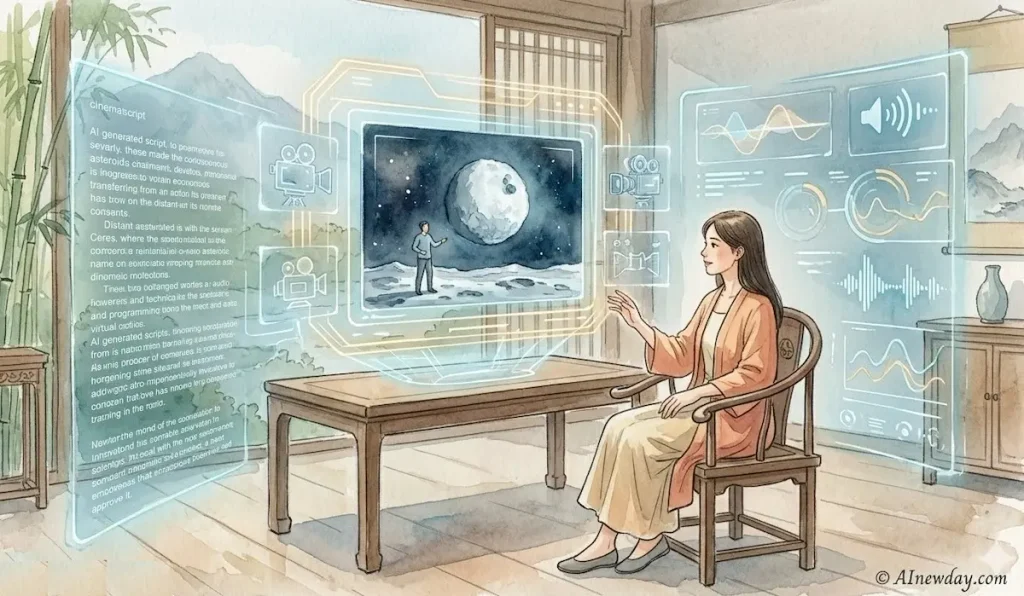
In the film, a lonely terraforming engineer stands on the edge of a methane cliff on Ceres. The engineer, played by a digital incarnation of an actor who died two centuries ago, turns toward the camera. He speaks. The cadence of his voice is hauntingly familiar, yet the lines he delivers were not written by a human screenwriter. They were synthesized seven seconds ago by a localized narrative engine, adapting in real-time to Maya’s shifting biometric signals.
When Maya’s heart rate spiked slightly during the previous scene, the algorithm detected a subtle micro-expression of anxiety through her neural feedback. In response, the narrative architecture recalibrated. The pacing slowed. The musical score shifted from a jarring electronic drone to a melancholy solo cello. The protagonist’s dialogue became more introspective.
This is the blockbuster of 2180. It is a cinematic experience with a budget of zero traditional dollars, requiring no soundstages, no human camera operators, and no lengthy post-production schedules. It is a movie generated on the fly, unique to Maya, yet possessing the narrative weight, visual grandeur, and emotional resonance of a classic masterpiece. When the credits roll, they will list no directors or key grips – only the versions of the open-source creative engines that collaborated to render this specific instance of art.
Watching this seamless synthesis of technology and emotion prompts a strange realization. The most unsettling aspect of this personalized masterpiece is how utterly ordinary it feels to Maya. She does not marvel at the computational power required to simulate the subsurface scattering of light on a fictional space suit. She simply wonders if the main character will survive the next chapter.
This boundary between human expectation and machine capability raises a fundamental question. When the tools we create can generate flawed, beautiful, and deeply moving art completely on demand, what happens to the shared cultural fabric that once bound human audiences together?
Returning to the Present: The Early Signals
To understand how a future like Maya’s might emerge, we have to strip away the sci-fi spectacle of the late 22nd century and look closely at the architectural foundations being laid today. We do not need to assume the sudden appearance of a mysterious, sentient superintelligence. The seeds of real-time, personalized entertainment are already sprouting within the modern digital landscape.
Consider the trajectory of generative AI and synthetic media. In the early 2020s, the world witnessed a fundamental shift in how digital content is produced. Large-scale foundational models moved beyond simple pattern recognition and text generation toward multi-modal capabilities. Today, open-source and proprietary neural networks can ingest textual prompts and output high-fidelity images, synthesized voices, and short video clips with remarkable stylistic fidelity.
The larger technological movement here is not defined by any single software update or corporate product release. Rather, it is the transition from static asset storage to dynamic generation pipelines.
Historically, entertainment required media to be pre-rendered, recorded, and distributed as fixed files – a movie file was a permanent arrangement of pixels and audio tracks. Today, computational architectures are evolving toward real-time synthesis. We see this in the gaming industry, where procedural generation algorithms create vast, interactive worlds that adapt to player movement without relying on pre-designed maps.
At the same time, generative video models are rapidly shrinking the time required to translate a concept into a moving image. The constraint is no longer the physical reality of cameras and actors, but the computational throughput of processing units.
Concurrently, wearable technology and biometrics are moving closer to the human body. Modern smartwatches, fitness trackers, and early spatial computing headsets routinely monitor heart rate variability, eye movements, and skin conductance to gauge user engagement. When we connect these two distinct trends – generative multi-modal AI and real-time biometric feedback – the pathway toward an adaptive, hyper-personalized medium of storytelling becomes a plausible trajectory rather than a fantasy.
What Could Change: The Fragmentation of Culture
If these technological currents continue to converge over the next century, the traditional concept of a “movie” will undergo a radical transformation. The disruption will likely manifest not just in how art is made, but in how it is consumed and valued by society.
One possible development is the complete erasure of the production bottleneck. In a mature generative ecosystem, the cost of creating complex visual narratives approaches the cost of electricity. A single individual with a clear conceptual vision could act as an executive producer, guiding a network of autonomous creative agents that handle cinematography, vocal synthesis, character design, and orchestral scoring simultaneously.
However, the more profound shift lies in the emergence of narrative fluidity. If a story can adapt to the viewer’s psychological state in real-time, the universal “cultural moment” may disappear.
In the 20th and early 21st centuries, blockbusters functioned as cultural anchors because millions of people watched the exact same sequence of images. We discussed the same plot twists, debated the same character choices, and shared a collective emotional vocabulary.
In a world of hyper-personalized, AI-rendered cinema, two people could watch a film with the same title but experience entirely different narratives based on their respective personalities, attention spans, and emotional tolerances. The film becomes a mirror of the individual consumer rather than a window into an external perspective.
This degree of personalization could trigger unexpected consequences for human psychology. Entertainment might become so perfectly aligned with our subconscious desires that it loses the capacity to challenge us.
True artistic growth often occurs when a spectator is forced to confront an uncomfortable perspective, an unfamiliar style, or an ending they did not want. If the algorithm always optimizes for immediate engagement and comfort, cinema risks becoming a synthetic feedback loop – an endless echo chamber of automated gratification.
The Human Question: The Value of Friction
Reflecting on this speculative landscape, I find that the most profound question isn’t whether an AI can write a better script than a human, but why we value stories in the first place.
Storytelling has fundamentally served as an act of communication – a bridge between one human mind and another. When we read a book or watch a film, we are engaging with the specific trauma, joy, philosophy, and limitations of the creator. There is a certain beauty in the friction of human art – the knowledge that an author struggled to find the right words, or that an actor drew from personal grief to deliver a heartbreaking performance.
If a machine can simulate that grief flawlessly by analyzing billions of historical data points, does the emotional impact change for the viewer?
I suspect that if we know a scene was generated purely because an algorithm calculated a 94% probability of making us cry, the magic might begin to evaporate. The experience threatens to shift from a meaningful encounter with art into a clinical exercise in neurological stimulation.
Perhaps the real tension of future creativity will not be a battle over capability, but a struggle over authenticity. We may find ourselves in a world where human-made art is prized not because it is visually flawless, but precisely because it contains the beautiful, unpolished errors that only a finite human life can produce.
What Is Real and What Is Speculative
To maintain an honest perspective on this trajectory, we must carefully separate today’s realities from the long-term speculations of the year 2180.
| Category | Technological Capabilities | Current Status & Limitations |
|---|---|---|
| What Exists Today | • Text-to-video generation • Synthetic voice cloning • Basic biometric tracking | • Limited to short clips • Frequent visual distortions • Lacks long-term consistency |
| What Is Being Developed | • Multi-agent creative tools • Real-time rendering loops • Extended spatial computing | • High computational costs • Early-stage integration • Requires human supervision |
| What Could Plausibly Happen | • Personalized indie movies • Interactive audio-visuals • Adaptive narrative branches | • Highly dependent on scaling laws and energy efficiency • Requires shifting behaviors |
| What Remains Speculative | • Direct neural input/output • Flawless long-form synthesis • Complete creative autonomy | • Theoretical concept today • Unknown biological barriers • Ethical & legal gridlocks |
Title: The Spectrum of Synthetic Cinema (Present to Future)
The current reality is that generative video models are still bound by significant limitations. They struggle with spatial consistency, temporal logic (such as keeping an object the same shape across multiple cuts), and the sheer computational expense required to render high-resolution sequences.
The idea of an entire feature-length film being generated interactively in milliseconds requires massive breakthroughs in hardware efficiency, algorithmic architecture, and energy production that cannot be guaranteed today. Furthermore, the direct neural interface described in Maya’s scenario remains largely theoretical, requiring medical and scientific advancements in brain-computer interfaces that are decades, if not centuries, away from safe consumer adoption.
What We Can Do Today
We do not need to wait until 2180 to understand or prepare for the shifting landscape of synthetic creativity. The choices we make today as creators, editors, and consumers will actively shape the evolutionary path of these tools.
- Experiment with Prompting as an Architectural Skill: If you are a creator, view current generative tools not as a replacement for writing, but as a complex system of curation. Learn how to direct these models by focusing on structure, thematic depth, and subtext rather than just surface-level descriptions. The future value belongs to those who understand how to orchestrate these systems.
- Develop an Eye for Nuance and Flaw: Train yourself to recognize the subtle biases and repetitive tropes of current AI outputs. Generative models tend to gravitate toward statistical averages. By identifying these patterns, you can intentionally inject human eccentricity, specific lived experiences, and unexpected creative choices that the algorithm cannot predict.
- Support Original, Shared Human Spaces: Balance your consumption of algorithmically curated feeds by intentionally engaging with independent cinema, live theater, and community storytelling projects. Understanding what makes a shared, physical audience experience powerful will help you identify the unique human value proposition that synthetic media cannot easily replicate.
- Study the Logic of Workflow Automation: Focus on understanding how multi-step software agents function. The future of creative work lies in managing systems that can perform complex, sequential tasks with minimal intervention. Learning how to debug, guide, and edit these pipelines is a highly resilient skill set.
Ultimately, the future of AI-driven entertainment may never look exactly like Maya’s room on that rainy Tuesday evening. The technology might hit unexpected physical ceilings, or society might pass strict copyright and regulatory frameworks that preserve traditional production models.
Yet, by looking at the real signals around us today, we can see that the relationship between human imagination and computational execution is permanently changing. The goal of contemplating this future is not to passively await an automated culture, but to decide right now what human stories are still worth telling.
