

Elena stood before The Quiet Recess, a piece occupying the central alcove of the Neo-Kyoto Gallery of Adaptive Mediums. The calendar on her wrist terminal softly glowed with the year: 2197. According to the gallery’s archival directory, the artwork was originally cataloged in the mid-22nd century as a landscape – a serene, minimalist study of autumn fog rolling over monolithic carbon-capture spires.
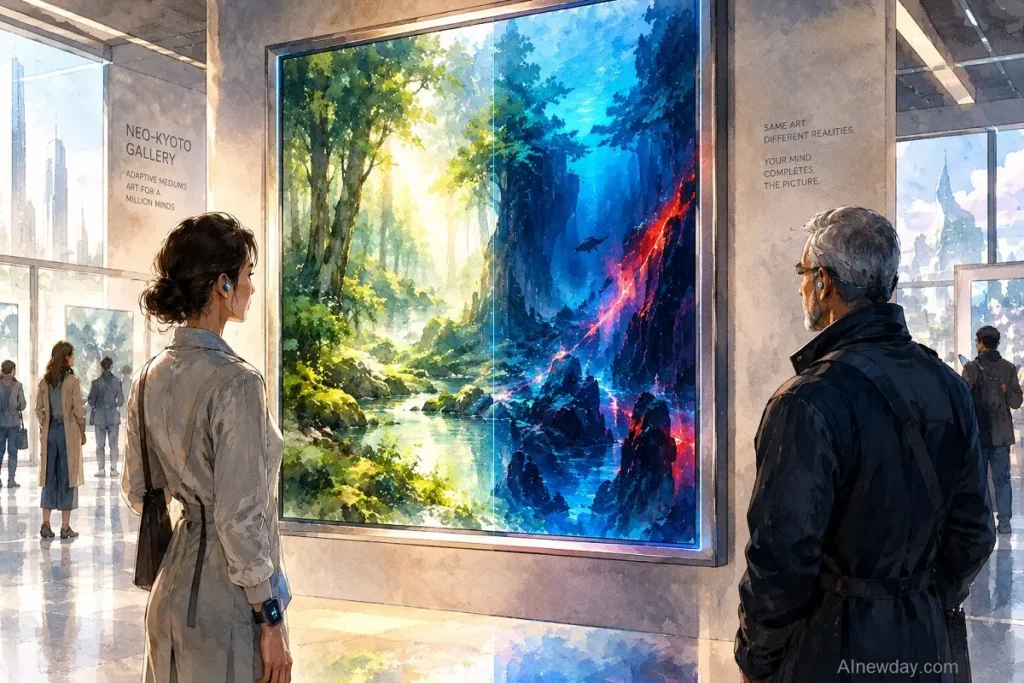
Yet, as Elena stepped within the three-meter perimeter, the fog on the canvas began to thin. The muted grays and slate blues shifted, recalibrating into a dense, vibrant canopy of emerald fern and moss-covered timber. A soft luminescence bled from the center of the frame, casting a warm light that mirrored the exact optical frequency of a late-afternoon sun filtered through a childhood bedroom window. Elena felt a faint tightness in her chest, a sudden, bittersweet wave of nostalgia for a rural landscape she hadn’t visited in over two decades. She breathed in, almost expecting the scent of damp earth.
Two paces to her right, an elderly man clad in the utilitarian linen of a deep-sea geothermal technician stopped to look at the same frame. He did not see the emerald canopy. Beneath his gaze, the canvas ripples into a violent, fractured abstraction of oceanic trenches, jagged neon fault lines, and deep indigo voids. The warm light Elena witnessed became a stark, pulsing crimson signal. He stood rigid, captivated by a geometric tension that seemed to speak directly to a lifetime spent navigating high-pressure abyssal zones.
Elena glanced from the shifting pigments back to the man’s weathered face. They were sharing a physical space, anchoring their eyes to the exact same physical frame hanging on a concrete gallery wall. Yet, they were inhabiting entirely separate aesthetic realities. The painting was not a static statement; it was a conversation, a biological and psychological mirror operating in real-time. It did not ask the viewer to interpret the artist’s intent. Instead, the artwork interpreted the viewer.
As Elena walked out of the gallery into the crisp evening air, the art remained trapped in its fluid state behind her, resetting itself for the next set of eyes. It leaves us with an uncomfortable, lingering question: When art becomes a flawless reflection of our own internal architecture, do we lose the ability to see outside ourselves?
Returning to the Present: The Architecture of the Shifting Signal
To a modern observer browsing the internet in the early 21st century, the fluid gallery of 2197 sounds like pure soft-sci-fi fantasy – a world governed by magical pigments and telepathic canvases. However, if we strip away the futuristic romance of Neo-Kyoto and examine the structural mechanisms required to make such an exhibition possible, we find that the foundational components are not centuries away. They are already operating in our laboratories, consumer electronics, and software frameworks today.
What exists today that makes part of this fluid future imaginable?
The realization of an adaptive aesthetic experience relies on three distinct technological vectors that are currently evolving in parallel: ambient biometric sensing, neural interface experimentation, and real-time generative software.
In our current technological landscape, spatial computing and wearable architecture are making digital environments feel increasingly physical. Modern eye-tracking arrays, embedded within contemporary virtual and mixed-reality headsets, can already map pupillary dilation, saccadic eye movements, and fixation points with millimeter precision. These systems do not merely track where a person looks; they collect raw data that can indicate cognitive load, neurological arousal, and emotional engagement.
Simultaneously, the field of generative AI is moving away from static, text-prompted inputs toward continuous, multi-modal feedback loops. Today’s advanced neural networks are capable of generating and altering visual assets dynamically, rendering frames on the fly based on contextual data streams. When we combine these generative pipelines with early-stage consumer health infrastructure – such as smartwatches that monitor photoplethysmography (heart rate variability) and galvanic skin response – we see the primitive skeleton of a system that monitors human emotion to alter digital output.
Furthermore, we must look at the accelerating domain of non-invasive brain-computer interfaces (BCIs). Current neurotechnology research regularly utilizes functional near-infrared spectroscopy (fNIRS) and electroencephalography (EEG) caps to decode emotional states or reconstruct crude visual imagery directly from human brain activity. Laboratories are no longer merely reading neural noise; they are beginning to translate that noise into actionable data that software can interpret.
When we observe these modern signals, we are looking at the scattered pieces of Elena’s fluid gallery. The modern world has already embraced the premise that media should adapt to the user. We see it in the algorithmic feeds that shape our information ecosystem and the adaptive audio landscapes designed to induce focus. The transition from an algorithm that curates a playlist based on your mood to a canvas that curates its own brushstrokes based on your neurological profile is not a leap of kind, but of degree.
What Could Change: The Mechanics of the Adaptive Mediums
If these contemporary technological signals continue to converge, the nature of creative expression and physical spaces could undergo a profound transformation. We are not looking at a sudden, overnight revolution, but rather a slow, iterative blending of material science and cognitive computing.
One possible direction this evolution could take involves the development of what researchers call “smart matter” or programmable surfaces. Imagine a physical canvas coated in an advanced layer of electrophoretic or organic light-emitting micro-particles, interconnected via a sub-dermal mesh of quantum-dot processors. Such a surface would possess the texture, depth, and light-reflective qualities of traditional oil paint, yet its physical properties – color, opacity, viscosity presentation – could be altered electronically at the molecular level.
In this speculative scenario, the gallery space itself becomes an active computational node. As a visitor approaches an artwork, ambient spatial sensors and unobtrusive BCI arrays woven into everyday garments establish a low-latency localized data link with the canvas. The artwork does not read the viewer’s explicit thoughts; rather, it samples a subconscious signature – a composite profile of current heart rate variability, neural resonance frequencies, optical fixation history, and perhaps an encrypted token of the viewer’s personal memories or cultural background.
The internal architecture of the artwork then uses this cognitive signature as a dynamic prompt. The painting begins to re-author itself. It might adjust the color palette to complement the viewer’s current neurological comfort zone, or deliberately introducing jarring geometric dissonance to challenge a state of cognitive apathy. A viewer experiencing high levels of acute stress might see a chaotic canvas gradually organize itself into a soothing, minimalist composition, acting as a biofeedback mechanism disguised as fine art.
Consequently, the role of the human artist would shift from creating a fixed artifact to designing an aesthetic probability space. The artist of the late 22nd century would no longer paint a singular landscape. Instead, they would author the rules of the transformation. They would define the boundaries of the canvas’s behavior, establishing the emotional vocabulary, the mathematical constraints of the forms, and the core thematic identity of the piece, while leaving the final execution to be completed by the mind of the spectator. The artwork becomes a collaborative ecosystem where the human artist provides the soul, the computing medium provides the canvas, and the viewer provides the muse.
The Human Question: The Echo Chamber of the Soul
I find the most unsettling part of this scenario isn’t the technology itself, but how ordinary it might eventually feel – and the quiet psychological price we might pay for it.
When we contemplate an environment where art actively morphs to accommodate our internal states, we must look past the technological novelty and interrogate the human consequences. Art has historically functioned as a vital cultural window, an empathetic bridge that forces us to step outside our own subjective consciousness and inhabit the mind, the struggles, and the distinct worldview of another human being. When you stand before a canvas painted by Vincent van Gogh or Frida Kahlo, you are confronting a fixed, uncompromising testament to their reality, their grief, and their ecstasy. You are required to do the cognitive work of adaptation.
What happens to the human psyche when that window is systematically replaced by a mirror?
If the artworks of 2197 shape themselves around our pre-existing emotional contours, we risk entering an era of absolute aesthetic isolation. If a canvas always softens its edges because it detects that I am anxious, I may lose the profound, transformative growth that comes from confronting uncomfortable art. We could inadvertently construct an emotional echo chamber – a physical manifestation of the digital filter bubbles that already fracture our contemporary public discourse.
Furthermore, this fluid dynamic introduces a profound crisis of shared human experience. In the opening scenario, Elena and the technician stood before the same frame but witnessed entirely different realities. If no two people ever see the same masterpiece, the communal vocabulary of human culture begins to dissolve. We can no longer meet in a café to discuss the striking use of shadow in a new exhibition, because the shadow I saw was tailored only to my brain, and the light you saw was configured only to yours. The collective agreement of what an artwork is breaks down into millions of unshareable, hyper-individualized illusions.
There is also the inevitable question of emotional autonomy and corporate or institutional oversight. If a canvas can read my subconscious cognitive signature well enough to alter its colors, it means the gallery – and by extension, the entities that build and maintain the software infrastructure – possesses real-time data regarding my deepest, unvoiced vulnerabilities. In an era of fully adaptive mediums, art could easily be weaponized as an invisible tool for behavioral modification, subtly shifting its forms to induce compliance, nudge consumer desires, or pacify social unrest without the viewer ever consciously realizing they are being manipulated.
What Is Real and What Is Speculative: Navigating the Map of Uncertainty
To maintain intellectual honesty, we must carefully separate the verified facts of our present world from the fascinating speculations of a distant century. The farther our thought experiments venture into timelines like 2197, the more we must acknowledge the massive, unpredictable chasms that lie between current lab experiments and widespread societal integration.
To clarify the boundaries of this projection, we can categorize the concepts discussed into four distinct levels of reality:
A. What Exists Today
- Generative AI networks capable of producing high-fidelity images, videos, and text dynamically based on prompt variations.
- Eye-tracking arrays embedded in commercial spatial computing platforms that monitor gaze direction, dwell time, and pupil response.
- Consumer wearables that accurately track biometric indicators such as heart rate variability, skin temperature, and blood oxygenation.
B. What Is Being Developed
- Non-invasive BCI devices, such as consumer-grade EEG headbands and laboratory fNIRS systems, designed to decode simple emotional states or map basic cognitive attention curves.
- Multi-modal AI architectures that attempt to synthesize real-time biometric inputs to adjust digital environments, gaming experiences, or background audio tracks.
- Early-stage experimental metamaterials capable of shifting color or transparency under direct electrical stimulation.
C. What Could Plausibly Happen
- The emergence of physical environments (galleries, workspaces, homes) where digital projections or adaptive surfaces modify their aesthetic presentation based on the collective emotional or cognitive state of the occupants.
- A fundamental shift in creative industries toward algorithmic co-creation, where artists curate complex software systems and rule-sets rather than fixed, unalterable products.
D. What Remains Highly Speculative
- The creation of physical “smart matter” or pigments that can seamlessly alter their molecular configuration, texture, and light reflection in real-time to mimic oil on canvas.
- The capability to accurately decode complex, highly subjective human emotions, personal memories, or nuanced psychological profiles via non-invasive, ambient sensors without active user training and calibration.
- The legal, economic, and social frameworks that would allow public spaces to continuously monitor and log the subconscious neural telemetry of citizens.
There is currently no scientific evidence that a physical painting can, or ever will, read a human mind to re-author its own physical brushstrokes. The scenario of Neo-Kyoto remains a long-range thought experiment – a narrative compass used not to predict the exact state of galleries two centuries from now, but to map the vectors of human desire and technological velocity operating in our world today.
What We Can Do Today: Cultivating the Grounded Mind
The true value of examining the fluid canvas of 2197 does not lie in trying to build it, nor does it require us to wait passively for its arrival. The purpose of speculative journalism is to make us look at the tools sitting on our contemporary desks with a renewed sense of clarity and critical awareness.
If we wish to prepare for a world where media increasingly seeks to adapt to our weaknesses, we must begin by intentionally cultivating our human skills today.
THE INTENTIONAL VIEWER: Practical Steps to Maintain Autonomy in an Adaptive Age.
1. ENGAGE WITH THE UNCOMPROMISING: Seek out traditional, fixed art forms. Spend time with art that does not change for you, forcing your mind to do the work.
2. DEMAND COGNITIVE SOVEREIGNTY: Be mindful of tools that track eye movements or biometric data. Advocate for privacy frameworks that protect neural telemetry.
3. RECLAIM THE COLLECTIVE EXPERIENCE: Discuss art, literature, and technology in group settings. Practice building shared vocabularies around static artifacts.
4. INTERROGATE THE ALGORITHMIC FILTER: Notice when digital feeds become too comfortable. Deliberately disrupt the personalization loops by seeking out dissonant views
First, we must practice engaging with the uncompromising. We can choose to regularly spend time with physical, static artifacts – whether they are oil paintings in a local museum, print books on a shelf, or vinyl records on a turntable. By anchoring our attention to mediums that refuse to alter their nature to accommodate our moods, we train our minds to lean into discomfort, build emotional resilience, and respect the unyielding voice of the creator.
Second, we must develop a sharp, protective awareness around our own biometric data. As spatial computing platforms and health wearables become more deeply integrated into our daily workflows, we should actively audit the permissions we grant. We must learn to ask: Who has access to our attention metrics? Where is our pupillary data being stored? We should advocate for strict boundaries around what can be called cognitive sovereignty – the principle that an individual’s subconscious neural and emotional responses should remain entirely private, protected from commercial extraction and algorithmic exploitation.
Finally, we must protect the collaborative human experience. We can foster spaces – clubs, salons, neighborhood forums – where people gather to debate, deconstruct, and share their interpretations of the world. The goal is to ensure that even if our screens and devices become increasingly hyper-personalized, our physical lives remain anchored in a shared, messy, and beautifully unoptimized reality.
We may never stand in the Neo-Kyoto gallery of 2197, watching the paint dissolve and reform beneath our gaze. But every time we choose to look at a piece of the world that refuses to change just to please us – and every time we work to understand a perspective that is not our own – we are deciding what it means to be human in an increasingly adaptive world.

A technology enthusiast based in An Giang, Vietnam. As the creator of AINewDay, I love exploring AI developments and turning complex tools into practical, everyday workflows. Follow my hands-on experiences, useful prompts, and creative insights to make your daily life more productive with AI.
