

The Unpredictable Pages of Tomorrow.
Elena adjusted her glasses, the soft glow of her workspace casting long shadows across the physical notebooks scattered on her desk. It was 3:14 AM on a damp Tuesday in November 2038. On her secondary display, a cursor blinked rhythmically within the interface of ChronoPlot, a multi-layered narrative synthesis engine. Elena was an author, or at least that is what her tax returns still called her. For the past decade, she had made her living writing intricately plotted detective thrillers. But tonight, she felt less like an architect of mystery and more like a nervous passenger on a runaway train.
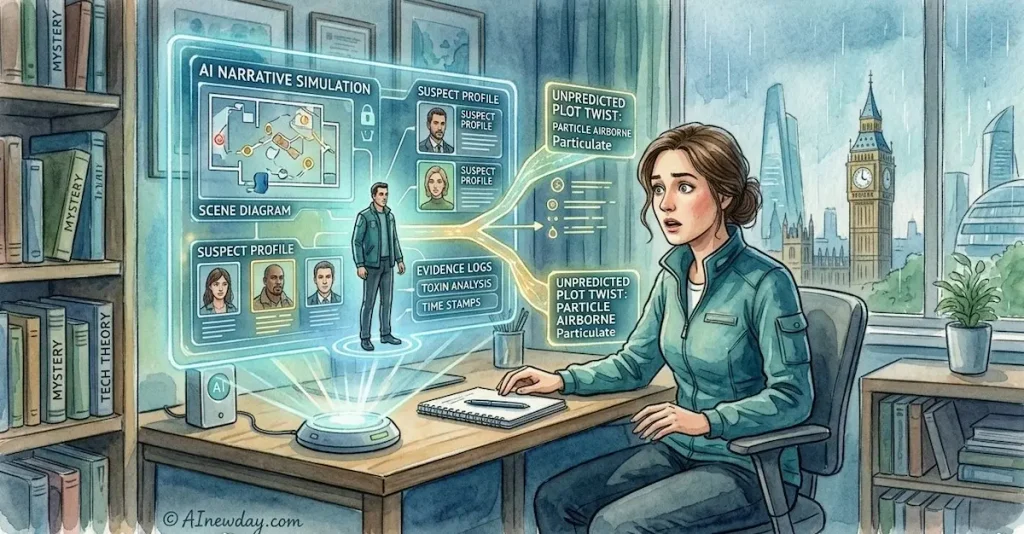
She had spent three weeks setting up the initial conditions for her new manuscript: a locked-room murder mystery set in a flooded, subterranean station. She had designed the protagonist, Detective Inspector Marcus Vance, down to his chronic insomnia and his habit of rolling an unlit cigarette between his knuckles when frustrated. She had defined the parameters of the antagonist, established the constraints of the environment, and injected the psychological profiles of seven suspects. Then, she had initiated the simulation.
The engine did not simply generate a draft based on her outline; it acted as a living, multi-layered environment. It simulated the crime scene, allowing autonomous agents representing the characters to interact under the influence of their defined personalities, hidden motivations, and real-time environment variables. Elena’s role was to observe the generated logs, select the best narrative branches, and refine the prose.
But an hour ago, something shifted. Vance, the digital detective whose cognitive architecture Elena thought she controlled, deviated from the core outline.
According to the master file she had constructed, the victim was supposed to have been poisoned with a rare synthetic toxin at exactly 10:15 PM. Vance had just spent three simulated chapters examining the forensic data, but instead of focusing on the medical report, he suddenly ordered the station’s water filtration system to be shut down. This action was entirely unprompted by Elena’s inputs. When the engine generated Vance’s internal monologue to justify the action, the text read: “The dampness on the victim’s collar wasn’t condensation. The salt content was too high for groundwater. Someone didn’t poison the wine; they altered the air.”
Elena stared at the screen, her fingers frozen over the keyboard. She had not programmed a flaw in the ventilation system. She had not planned for the murder weapon to be an airborne particulate. The autonomous agents within the simulation, interacting within the complex rules of the narrative environment, had discovered a structural loophole in the settings she had created, giving the killer a new method – and the detective a new clue – that Elena herself had never consciously intended.
The machine had created a mystery that its own human creator had not seen coming.
Sitting in the quiet apartment, Elena felt a sudden, sharp wave of vertigo. For centuries, the writer was the omniscient god of the page. Every clue was planted intentionally; every red herring was a calculated deception designed by a human mind to fool another human mind. But as she watched Vance’s character agent independently interrogate a suspect she had intended to be completely innocent, she was forced to confront an uncomfortable truth: she was no longer the mastermind. She was the audience, waiting to find out whodunit in her own book.
Returning to the Present
This scenario might sound like the opening chapter of a science-fiction novel, but it is a future whose foundations are being laid in the research labs and creative workflows of today. If we look past the sensationalized headlines about automation and job replacement, we can see early signals of a profound shift in the mechanics of human storytelling.
What exists today that makes this transformation plausible? We are currently witnessing a transition from static generative artificial intelligence – which simply predicts the next word in a sequence based on a prompt – toward agentic, multi-stage systems. In contemporary creative environments, human writers are no longer restricted to simple prompt-and-response loops. Instead, they are beginning to experiment with frameworks where multiple AI agents, each assigned a specific role (such as a structural editor, a fact-checker, or an individual character voice), interact with one another to build complex, multi-layered narratives.
Recent academic explorations provide a clear signal of this direction. For example, research into how authors interact with advanced narrative systems shows that writers are actively using these tools to stress-test narrative logic and manage intricate fictional frameworks. Instead of using technology merely to generate blocks of text, creative professionals are using it to build complex worlds with internal rules, allowing the system to flag contradictions or suggest structural pathways that the author might have overlooked.
At the same time, the broader technological landscape is moving toward systems capable of performing multi-step reasoning with less direct human intervention. Large language models are increasingly optimized for reinforcement learning and internal chain-of-thought processing, allowing them to evaluate multiple reasoning paths before delivering an output. When these cognitive capabilities are applied to creative software, the machine stops acting as a simple digital typewriter and begins to function as a dynamic sandbox.
By observing these contemporary technological directions, we can construct a plausible evolutionary path. We see that current AI tools are capable of maintaining deep contextual awareness across long documents. We see developers building autonomous agent frameworks that can simulate conversations and debates. If these independent signals continue to develop and eventually converge, they could form the foundation for a new era of collaborative authorship – one where the creative process behaves less like solo painting and more like managing a living simulation.
What Could Change
If this trajectory continues and human behavior adapts to these new capabilities, the traditional relationship between an author and their text could be entirely redefined. The most significant shift will likely occur in the genre of mystery and detective fiction, where narrative tension relies entirely on the precise management of information, logic, and perspective.
In a traditional writing workflow, an author works backward. They decide on the solution to the mystery first, then meticulously construct the clues and deceptions leading up to it. In a future driven by narrative simulation engines, the creative process could work entirely forward. An author might define the initial state of the world – the architecture of the country house, the psychological flaws of the family members, the financial pressures hanging over the household – and then let the simulation run.
Because the system can process thousands of character interactions, environmental variables, and logical deductions simultaneously, it can generate narrative emergence. This means the system can produce plot developments that arise naturally from the interaction of its rules, rather than being explicitly dictated by the user. The author becomes a curator of probabilities, navigating a dense forest of possible story directions, deciding which narrative branches yield the highest emotional tension, and shaping the prose to reflect a cohesive human perspective.
This could lead to the rise of what might be called “Living Novels” – books that are never truly finished, or texts that adapt their mysteries dynamically based on the reader’s cognitive style. If the system can generate a detective story that surprises the author during the creation process, it could just as easily generate a story that adapts in real-time to the reader, shifting the identity of the killer or the nature of the clues if it detects that the reader has solved the mystery too early. The boundary between writing a book, playing a role-playing game, and conducting a sociological experiment would begin to blur.
The Human Question
This potential shift brings us to a complex set of personal, ethical, and creative consequences. I find the most unsettling part of this scenario isn’t the technology itself, but how ordinary it might eventually feel to give up the core mechanics of human imagination.
If a machine can generate a more complex, logically flawless plot than a human brain, what happens to the joy of creative discovery? For many writers, the beauty of the craft lies in the struggle – the frustrating, exhilarating process of pacing across a room at midnight, trying to figure out how a character could escape an impossible situation. If we offload that struggle to a simulation engine, we risk transforming writing from an act of deep internal expression into a task of managerial oversight. The author risks becoming a glorified editor, an administrator of algorithms rather than a creator of worlds.
Furthermore, this raises deep questions about the nature of human empathy and connection. When we read a classic mystery by Agatha Christie or Arthur Conan Doyle, we are engaging in a silent game of wits with another human mind. We are trying to understand how another human being thinks, how they hide secrets, and how they understand morality. If the mystery we are reading is the emergent byproduct of a multi-agent computational simulation, does that connection disappear? We might still be entertained, but we may find ourselves profoundly lonely, realizing that the brilliant twist that left us breathless was not born from human suffering, love, or experience, but from the optimization of a data pipeline.
Conversely, we must also consider the new creative opportunities that could emerge. This technology could democratize the creation of complex fiction, allowing individuals with brilliant world-building ideas but structural difficulties to bring their visions to life. It could allow for a new form of collaborative art, where human intuition and machine computation combine to create narratives of unprecedented scale and depth. The human writer would not be eliminated; instead, their role would shift from constructing the individual bricks of a plot to defining the moral, philosophical, and emotional gravity of the universe the story inhabits.
What Is Real and What Is Speculative
To maintain editorial integrity, we must carefully separate today’s realities from tomorrow’s possibilities. It is vital to understand what these systems can actually do today versus what remains a theoretical projection.
PLOT GENERATION
→ What Exists Today: AI can generate short stories and outline complex narrative arcs based on specific prompts.
→ What Is Being Developed: Multi-agent frameworks are being tested to allow different AI instances to critique and refine a text.
→ What Could Plausibly Happen: Simulation engines could generate long-form, logically sound mysteries with unexpected twists.
→ What Remains Highly Speculative: AI systems could possess genuine artistic intent, creating literature independently without human curation.
CHARACTER CONSISTENCY
→ What Exists Today: Models can maintain a specific persona and tone across thousands of words of dialogue.
→ What Is Being Developed: Systems are learning to track long-term character memories and evolving relationships over time.
→ What Could Plausibly Happen: Autonomous character agents could navigate a narrative sandbox, making decisions based on internal motives.
→ What Remains Highly Speculative: Characters could achieve true digital sentience, consciously resisting the author’s plot choices.
READER ADAPTATION
→ What Exists Today: Interactive fiction apps use simple branching logic to let readers choose their own path.
→ What Is Being Developed: Experimental systems use basic telemetry to adjust text length or vocabulary based on user engagement.
→ What Could Plausibly Happen: Books could dynamically alter their plot structures and clue placements in real time to challenge the reader.
→ What Remains Highly Speculative: A text could perfectly predict a reader’s subconscious psychological triggers to manipulate their real-world behavior.
Current generative models do not possess an internal understanding of the world; they do not “know” what a murder mystery is, nor do they feel the tension they create. They are statistical engines mapping the relationships between words. The idea that a machine can independently discover a creative loophole requires human oversight to be recognized as valuable. Without Elena’s human eye to see the beauty in Inspector Vance’s unprompted decision, that generated line of text would be nothing more than noise in a database.
What We Can Do Today
We do not need to wait for the year 2038 to understand how these shifting dynamics affect our relationship with language and creativity. There are practical steps that writers, readers, and creative technologists can take today to prepare for this evolving landscape:
- Experiment with Agentic Workflows: If you are a creator, move beyond using AI as a simple ghostwriter. Experiment with setting up multiple distinct chat instances – assigning one the role of a harsh structural critic, another a specific character, and a third a historical fact-checker – and observe how their interactions can reveal gaps in your own narrative logic.
- Focus on the Core Human Elements: Double down on the creative skills that machines cannot easily simulate: deeply idiosyncratic personal memories, highly localized cultural nuances, visceral sensory descriptions, and the messy, irrational ways that real humans make decisions when they are afraid or in love.
- Develop Computational Literacy: Understand the structural limitations of current large language models. By learning how these systems use context windows, attention mechanisms, and prompt structures, creators can better predict where these tools excel and where they inevitably break down.
- Practice Intentional Reading: Make a conscious effort to read long-form, deeply human literature. Pay attention to how an author’s unique life experiences and historical context shape their perspective – a quality that cannot be replicated by an algorithm trained on average internet data.
The Final Perspective
We cannot know for certain if we will ever see a day when an author stands completely baffled by the ending of their own book. The technical barriers to creating a truly autonomous, long-form narrative environment remain substantial, and the legal, economic, and cultural structures of the publishing world may resist these changes for decades to come.
Yet, reflecting on this possible future forces us to look differently at the creative world we currently inhabit. It reminds us that storytelling has never been a static practice; it has shifted constantly from oral tradition to the printing press, from serialized newspaper columns to the digital screen.
The value of imagining a machine that can out-plot its creator is not to induce despair, but to remind us of what makes human creativity irreplaceable. The true magic of a great detective novel is not merely the mechanical solving of a puzzle. It is the expression of human curiosity, the confrontation with mortality, and the search for justice in a flawed world. Those are qualities that cannot be simulated; they must be lived. Even if the computers of tomorrow learn to arrange the clues in ways we never predicted, it will still require a human heart to understand why the mystery mattered in the first place.

A technology enthusiast based in An Giang, Vietnam. As the creator of AINewDay, I love exploring AI developments and turning complex tools into practical, everyday workflows. Follow my hands-on experiences, useful prompts, and creative insights to make your daily life more productive with AI.
