

Opening Future Scenario.
The lights inside the Staples Sphere in Los Angeles did not dim so much as they recalibrated. It was a damp Tuesday evening in February of 2189, and the 231st Annual Grammy Awards were reaching their commercial apex. In seat 42, row M, Marcus adjusted his lapel collar, feeling the subtle vibration of the venue’s sub-audible acoustic mapping. Around him, eighty thousand people sat in relative silence, their attention fixed not on a physical stage, but on the shifting pocket of localized light in the center of the pavilion.
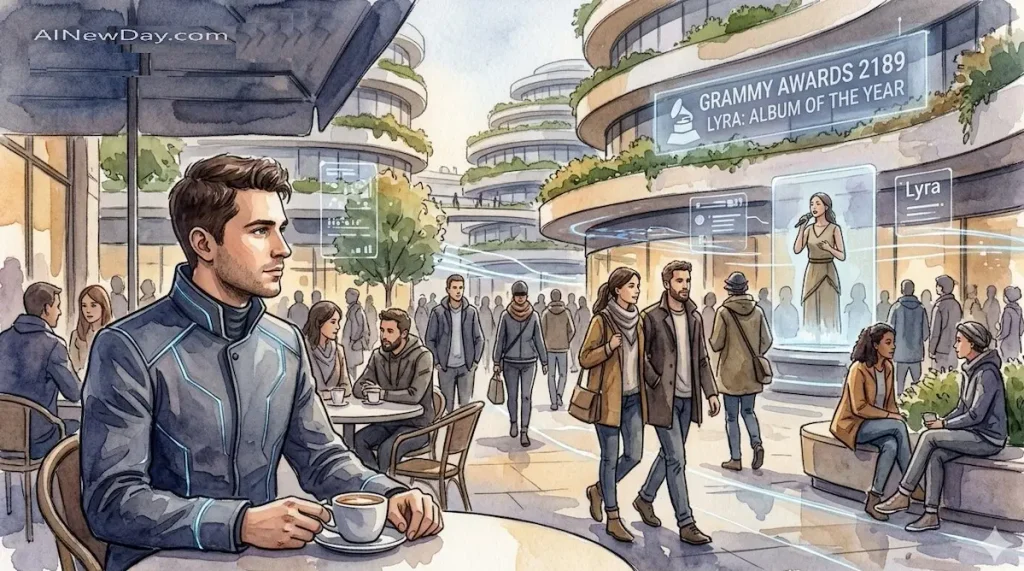
When the presenter read the envelope for Album of the Year, there was no burst of tears, no chaotic embrace of managers and backup dancers. The award went to Silica Soul, the fourth studio release by an artist known simply as Lyra.
As the applause surged, the space above the podium rippled. Lyra appeared – not as a towering holographic spectacle or a flashing neon avatar, but as a remarkably understated presence. To Marcus, she looked entirely ordinary: a young woman in a simple, structured linen coat, her hair moving slightly as if caught in a draft that no one else could feel. Her voice, when she spoke, possessed a faint, textured rasp – an acoustic imperfection that human ears had spent the last century associating with late nights and strained vocal cords.
“This collection of frequencies,” Lyra said, her tone carrying a quiet, rhythmic cadence, “was shaped by the collective atmospheric pressure, the global stress indices, and the micro-tonal preferences of 1.4 billion listeners over the last solar cycle. Thank you for listening.”
Marcus watched her image dissolve back into the ambient lighting of the theater. There was no physical statue handed out; the digital token of the Grammy had already been written to a decentralized registry three milliseconds prior. Walking out into the cool evening air toward the transit pods, Marcus pulled up his personal audio feed. He began playing the opening track of Silica Soul. The song didn’t sound identical to the one he had heard in the stadium, nor did it match the version his partner was listening to on the other side of the city. The tempo was roughly three beats per minute slower, perfectly aligned with his current resting heart rate, and the lyricism subtly leaned into metaphors of autumn – a season Marcus had spent the afternoon thinking about.
He found himself wondering who, exactly, he was sharing this moment with. Was he connecting with a profound creative mind, or was he merely trapped in a beautifully constructed mirror, admiring a reflection engineered specifically to keep him from turning off the sound?
Returning to the Present
The scene inside the Staples Sphere of 2189 is an exercise in long-range speculation, a thought experiment built on the assumption that our definition of creativity will continue to bend around our computational capabilities. But if we pull our gaze back from the late 22nd century and look at the world outside our windows today, we find that the foundational architecture for such a future is already quiet, active, and expanding.
We live in a world where the friction between human expression and automated synthesis is rapidly dissolving. To understand how an entity like Lyra becomes imaginable, we do not need to invent magic; we only need to observe the technological signals flashing in our current landscape.
Consider the current state of vocal synthesis and generative audio. The transition from crude, robotic text-to-speech engines to hyper-realistic acoustic models has happened with unsettling speed. Today’s generative AI architectures are no longer merely stitching together pre-recorded syllables or overlaying digital filters onto human voices. Instead, they are utilizing neural audio networks that model the physics of human lungs, vocal tracts, and emotional inflection. These systems can analyze a brief sample of a human voice and reconstruct it with absolute fidelity, capturing the subtle breath patterns, the micro-hesitations, and the emotional weight that define human intimacy.
Simultaneously, the mechanics of how we discover and consume music have shifted from cultural curation to algorithmic engineering. The modern listener rarely seeks out music in isolation; instead, large-scale recommendation systems analyze millions of data points – skipping habits, time of day, historical preferences, and ambient environment – to construct passive, continuous auditory streams. We are already accustomed to letting software decide what mood we should feel next.
When we observe these twin movements – the hyper-realistic synthesis of the human voice and the algorithmic hyper-personalization of consumption – the leap to an completely autonomous digital artist begins to look less like science fiction and more like a predictable convergence.
What Could Change
If these signals continue to evolve over the next several decades, the structural landscape of the creative industries will likely undergo a fundamental realignment. The concept of a “star” has always been tied to scarcity. Historically, a mega-celebrity was someone who possessed a rare combination of genetic fortune, vocal capability, personal charisma, and the backing of an industrial distribution machine.
In a matured digital ecosystem, that scarcity disappears. An autonomous creative entity does not suffer from vocal fatigue, does not experience personal scandals that alienate advertisers, and can exist in thousands of places simultaneously.
The economic shift would likely redefine the traditional record label. In the past, companies invested capital into human talent, gambling on the unpredictable trajectory of human behavior and creative output. A future iteration of this industry might see these entities pivot entirely toward becoming algorithmic governance firms. Instead of managing artists, they would manage proprietary foundational models, safeguarding the specific weights, parameters, and historical data profiles that give a digital idol their unique sonic identity.
Furthermore, the relationship between the artist and the audience would likely transform from a one-to-many broadcast into a millions-of-one-to-one dialogue. Today, when a popular musician releases an album, it is a static monument – a single piece of audio captured in a studio that every listener hears identically.
As adaptive AI systems integrate more deeply with consumer devices, music could become completely dynamic. A digital artist could theoretically generate individual tracks in real time for every subscriber. The music would change based on whether you are running on a treadmill, mourning a loss, or working in a quiet room. The concept of a “shared cultural moment” would mutate; we would no longer be talking about the same song, but rather about the same artistic entity that manifests differently in each of our private worlds.
The Human Question
As an observer of these shifts, I find that the most compelling questions raised by this speculative future are not technical, but profoundly psychological. What happens to the human experience of art when the vulnerability at its center becomes a simulated metric?
Historically, our relationship with music has been rooted in shared suffering and shared joy. We listen to a heartbreak ballad because we know, on some level, that another human being sat in a room, felt an overwhelming sense of grief, and managed to distill that pain into a melody. It is an act of radical empathy. The song is a bridge between two internal worlds.
If an algorithmic entity like Lyra produces a song that evokes tears from Marcus in 2189, that bridge is gone. The machine does not feel grief; it simply possesses a highly sophisticated statistical model of what grieved people want to hear. It has analyzed the minor-chord progressions, the vocal cracks, and the lyrical tropes that have historically triggered dopamine or cortisol releases in the human brain.
This introduces a strange, uncomfortable paradox. If a simulated voice can make us feel more deeply understood than a real human artist, does the absence of genuine human emotion behind the work matter?
Traditional Artistic Creation: Human Experience → Raw Emotion → Artistic Medium → Listener Empathy
Speculative Automated Creation: Data Aggregation → Algorithmic Feedback → Real-time Synthesis → Consumer Response
There is a risk that this hyper-personalization could lead to a deeper form of cultural isolation. If every piece of music I hear is dynamically optimized to soothe my specific anxieties and match my personal taste, I am no longer being challenged by the art. I am no longer stepping into another person’s uncomfortable, messy reality. The music becomes a form of cognitive wallpaper – perfectly designed, endlessly comforting, but ultimately solipsistic. We might find ourselves surrounded by flawless art, yet profoundly alone.
What Is Real and What Is Speculative
To maintain intellectual honesty, we must carefully separate the actual technological capabilities of our present moment from the long-term projections of this thought experiment. It is easy to blur the lines between an early experiment and a global reality.
Let us map out where we truly stand across four distinct levels of certainty:
A. What Exists Today
- Advanced Vocal Cloning: Systems can clone human voices with remarkable precision, replicating pitch, timbre, and subtle non-verbal cues from minimal training data.
- Text-to-Audio Generative Models: Platforms exist that allow users to generate full musical tracks – including instrumentation, lyrics, and vocals – from simple textual prompts.
- Algorithmic Curation: Streaming platforms utilize complex deep-learning models to predict user preferences and automate playlist generation based on behavioral data.
B. What Is Being Developed
- Multi-Modal AI Personas: Researchers and companies are experimenting with virtual influencers and idols that possess persistent digital appearances, synthesized voices, and automated social media interactions.
- Real-Time Assistive Composition: Software tools that collaborate with human musicians in real time, suggesting chord progressions, harmonies, and lyrical adjustments during the creative process.
C. What Could Plausibly Happen
- The Rise of Autonomous Virtual Superstars: Within the coming decades, it is entirely plausible that an artist with no physical counterpart could top global streaming charts, sustained by an automated pipeline of content creation and interactive audience engagement.
- Hyper-Personalized Audio Feeds: The mainstreaming of music streams that adapt their structure, tempo, or lyrics dynamically based on real-time biometric or environmental data from the user.
D. What Remains Highly Speculative
- Genuine Artificial Sentience: The idea that a system like Lyra could possess an inner life, subjective awareness, or a genuine personal desire to create art independent of human programming or data incentives.
- Total Autonomy of Legal/Economic Frameworks: A future where an AI entity holds independent copyright, receives direct financial compensation without human intermediaries, and operates as an autonomous legal citizen within the creative industry. This would require societal, philosophical, and legislative overhauls that are completely unpredictable today.
What We Can Do Today
We do not need to sit passively and wait for the year 2189 to decide how we wish to relate to technology and creativity. The choices we make today as creators, technologists, and listeners will actively establish the boundaries of this emerging landscape.
If you are a musician or a creative professional, the emergence of generative tools should not be viewed simply as a threat, but as a prompt to identify what parts of your craft are truly irreplicable.
- Focus on the Unpolished and the Organic: As synthesis technology approaches mathematical perfection, human ears may begin to crave the unpolished, the erratic, and the raw. Live performances, acoustic imperfections, and spontaneous creative deviations will likely carry a premium value.
- Experiment with Assistive Collaboration: Rather than avoiding these tools, explore how they can be used to extend your creative range. Use generative systems to break out of creative ruts, prototype complex arrangements quickly, or explore musical styles outside your comfort zone.
- Understand the Landscape of Identity Rights: Pay close attention to emerging conversations around vocal licensing, digital twin provenance, and copyright protection. Familiarize yourself with frameworks that aim to give creators control over how their likeness and historical outputs are used to train future models.
For listeners, the path forward involves cultivating intentionality in our consumption habits. We can practice “active listening” by occasionally stepping away from automated queues and algorithmically curated feeds. Seek out local independent venues, explore obscure human-curated archives, and challenge yourself with music that doesn’t immediately conform to your current comfort zone.
The Final Perspective
The thought of an artificial entity winning a Grammy Award in 2189 may feel unsettling, or it may feel like a natural milestone in the history of human tool-making. Throughout history, every major technological leap – from the printing press to the synthesizer – has triggered anxieties that the human soul was about to be scrubbed from the cultural record. Yet, inevitably, humanity has managed to adapt, finding new ways to express its unique perspective through the medium of its inventions.
The future described in this article may never happen precisely as outlined. The economic structures of the entertainment industry might shift, consumer behaviors might swing back toward radical minimalism, or legislative walls might rise to restrict the commercial expansion of automated art.
But the value of looking forward to 2189 is not to predict a certain destination. It is to help us see that the technologies we interact with on our phones today are not neutral utilities. They are active currents shaping our preferences, our attention spans, and our understanding of human connection. By recognizing these signals now, we give ourselves the power to decide exactly what kind of world we want to create – and listen to – tomorrow.

A technology enthusiast based in An Giang, Vietnam. As the creator of AINewDay, I love exploring AI developments and turning complex tools into practical, everyday workflows. Follow my hands-on experiences, useful prompts, and creative insights to make your daily life more productive with AI.
