

Opening Future Scenario.
The bathroom illumination at 6:45 AM does not merely light up the room; it calibrates itself to the exact state of your nervous system. Elena stands barefoot on the warm slate floor, leaning slightly toward the silver-halide surface of her vanity. To an observer from a decade ago, she is simply brushing her teeth. To the glass pane in front of her, she is a shifting tapestry of biometric data.
Beneath the glass, a sub-epidermal optical scan unrolls. In the lower-left quadrant of her reflection, tiny illuminated numbers pulse in rhythm with her carotid artery: 72 bpm. A translucent heat map overlays her forehead, shifting from an amber hue to a cool teal as she completes her morning routine.
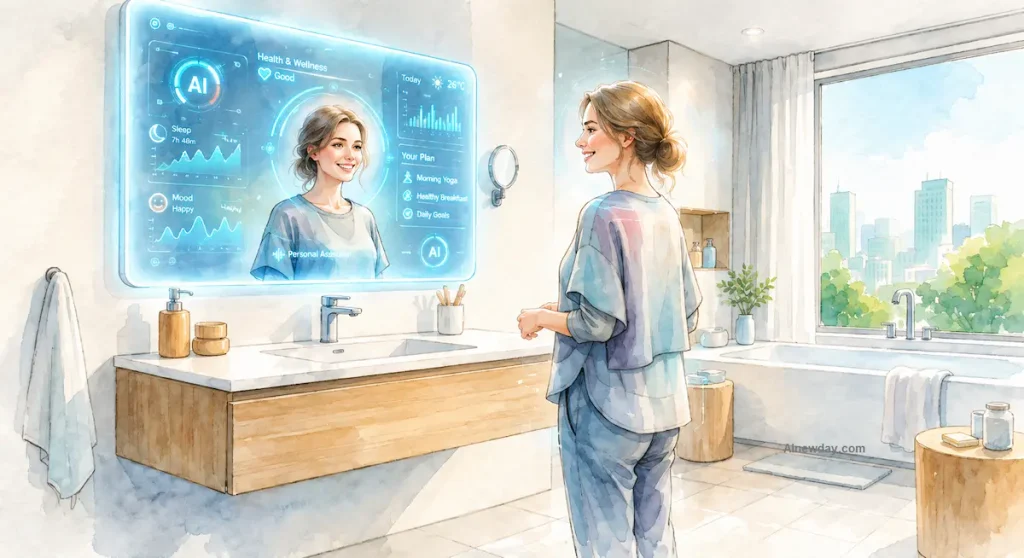
“Good morning, Elena,” a low, localized audio beam murmurs from the acoustic glass, audible only within her direct radius. “Your heart rate variability is down by 14% compared to your rolling Tuesday baseline. The sub-visual tremor detected around your eyes suggests elevated cortisol. Did the thunderstorm interrupt your deep sleep phase at 3:12 AM?”
Elena spits out her toothpaste, rinses, and sighs. “Yes, actually. I felt exhausted waking up.”
The mirror’s surface flickers subtly, transitioning from her physical reflection into a soft, data-rich dashboard. “Understood. Your physiological age index has bumped forward by three months this morning due to acute vascular restriction. To stabilize your nitric oxide levels and bring your metabolic trajectory back to center, I have updated your kitchen hub. Your morning espresso has been dialed down to a single shot of decaf, supplemented with L-theanine. I have also queued a four-minute box-breathing sequence onto your commuting display.”
Elena stares at her own eyes in the glass. The system is right, of course. It knows her better than she knows herself. But as she watches her digital wellness score fluctuate from a healthy green into a cautionary amber, a faint, familiar pang of anxiety flutters in her chest. She wonders briefly if the anxiety is caused by her poor sleep, or by the glass pane that refuses to let her ignore it.
Returning to the Present
The scenario described above sounds like a fragment torn from a near-future science fiction novel. Yet, if we pull back from the imagined world of tomorrow and look closely at the technological signals surrounding us today, we discover that the foundation for this reality has already been laid. The ordinary bathroom mirror is undergoing a profound mutation.
What exists today that makes part of this future imaginable? We do not need to project centuries ahead to find the roots of this technology. Over the past few years, the consumer electronics landscape has seen a significant shift away from passive data tracking toward highly integrated, ambient biometric capture.
Consider the recent advancements showcased at global technology events. In early 2025, health-tech developers introduced conceptual smart mirrors designed to gather data from an array of separate household devices – smartwatches, connected scales, and blood pressure cuffs – consolidating them into a singular, reflective dashboard. By early 2026, the technology took a major leap forward from mere data consolidation to active, contactless measurement. Devices like the NuraLogix Longevity Mirror entered the public sphere, utilizing a technology known as Transdermal Optical Imaging (TOI). By using specialized cameras to read the subtle changes in blood flow underneath human facial skin, these modern systems can track heart rate, blood pressure, stress indexes, and metabolic markers in a 30-second glance – all without a single wire touching the human body.
At the same time, the broader technological movement is shifting from reactive tools to autonomous AI agents. Generative AI models are no longer confined to text boxes on a desktop screen. They are converging with computer vision systems and edge-computing hardware, enabling physical objects to see, interpret, and talk back to us in real time. When we couple contactless biometric imaging with deep-learning health architectures, the bathroom mirror ceases to be a passive piece of furniture. It becomes a permanent, ambient medical screening portal.
What Could Change
If these existing technological directions continue to evolve and converge, the way we manage human health will fundamentally alter. For generations, healthcare has been fundamentally reactive. We visit a clinic or a hospital only after symptoms manifest – when the pain becomes too severe, the fatigue too heavy, or the cough too persistent.
An ambient AI wellness companion introduces a paradigm shift: the era of continuous, frictionless diagnosis.
In a fully realized version of this future, the bathroom mirror becomes the central node of a domestic health network. Because looking into a mirror is an involuntary, deeply ingrained daily habit, tracking becomes completely passive. There are no smart rings to charge, no watch straps to tighten, and no apps to open manually. The barrier to personal health literacy drops to zero.
The true transformation, however, lies in the predictive capabilities of these systems. As machine learning models train on longitudinal data – years of observing the exact same face every single morning – they will become adept at spotting microscopic anomalies long before they trigger physical discomfort. A slight shift in facial asymmetry could flag the earliest warnings of neurological decline. A subtle change in vascular elasticity, captured via high-resolution optical sensors, could predict a cardiovascular event months in advance. The home environment shifts from a place of mere shelter to a proactive shield, constantly tuning our nutrition, sleep environments, and daily habits to optimize our biological longevity.
The Human Question
As a writer observing these advancements, I find that the most unsettling part of this scenario isn’t the technological complexity itself, but how completely ordinary it might eventually feel. Human beings possess an extraordinary capacity to normalize the radical. Within a few months of installation, a mirror that reads your blood vessels becomes no more shocking than a smartphone that unlocks via facial recognition.
Yet, we must pause to ask: what happens to the human psyche when our most private spaces are turned into arenas of permanent algorithmic evaluation?
The bathroom mirror has historically been a sanctuary for raw human vulnerability. It is where we look at ourselves without pretense when we first wake up – messy, exhausted, aging, and intensely human. If we replace that silent space with an AI companion that grades our appearance, calculates our stress levels, and assigns a numerical index to our well-being, we risk turning self-reflection into a performance for a machine.
Furthermore, this technological convergence introduces profound contradictions regarding human autonomy:
- The Anxiety of Perpetual Tracking: When a machine constantly warns you about invisible biological risks, does it empower you to live better, or does it trap you in a state of perpetual health anxiety (hypochondria driven by algorithms)?
- The Erosion of Personal Choice: If your mirror dictates your morning routine based on your stress metrics, at what point do you surrender your right to make bad, beautifully human choices? Will we still feel free to stay up late reading a book, or enjoy a rich cup of coffee, if we know our reflection will scold us for it the next morning?
- The Boundary of Privacy: A device capable of scanning the blood vessels under your skin is inherently a surveillance device. If this highly intimate biometric data is stored in the cloud, it becomes a prime target for corporate exploitation. Could insurance providers eventually demand access to your mirror’s history to adjust your premiums?
The real tension is not whether we can build these ambient health companions – we are already doing so. The question is whether we can invite them into our homes without letting them strip away our peace of mind.
What Is Real and What Is Speculative
To maintain the editorial integrity that defines our explorations at AINewDay.com, we must establish a clear boundary between contemporary fact and future extrapolation. It is easy to blur the lines when discussing artificial intelligence, but an honest look at the horizon requires careful categorization.
What Exists Today
As verified by current market developments, contactless facial biometric scanning via standard or specialized camera sensors is a functional reality. Systems can accurately measure heart rate, heart rate variability (HRV), and respiration rates using remote photoplethysmography (rPPG). Consumer electronics companies have successfully built prototype mirrors that integrate these sensors into household displays.
What Is Being Developed
Autonomous AI health assistants capable of translating complex biometric data into conversational lifestyle advice are under active development. Current research in multi-modal AI models is focused on combining visual data (what the camera sees) with physiological history to generate personalized wellness recommendations.
What Could Plausibly Happen
Within the next decade, it is highly plausible that smart mirrors will become standard fixtures in premium smart homes, acting as preventive health dashboards that communicate directly with other domestic appliances (such as kitchens and lighting systems) to automatically adjust environments based on user biometrics.
What Remains Highly Speculative
The claim that home smart mirrors can perfectly diagnose complex diseases or accurately predict a person’s lifespan 20 years in advance with clinical absolute certainty remains highly speculative. While marketing materials for emerging tech often use optimization scores like a “Longevity Index”, these are consumer-grade wellness approximations, not validated medical diagnostics. True clinical-grade, autonomous medical intervention inside a mirror faces monumental regulatory, legal, and scientific hurdles that cannot be assumed to clear anytime soon.
The Ambient Health Horizon:
REAL TODAY → Contactless facial biometric scanning (rPPG).
BEING DEVELOPED → Multi-modal AI conversational health coaches.
PLAUSIBLE TOMORROW → Fully integrated smart homes tuning to wellness metrics automatically.
HIGHLY SPECULATIVE → Flawless, independent clinical diagnoses without human physicians.
What We Can Do Today
We do not have to wait for the future to happen to us; we can choose how we interact with the early signals of this technology today. If the concept of ambient wellness companions interests or concerns you, here are practical ways to engage with the movement right now:
- Experiment with Contactless Tech: You do not need to buy an expensive smart mirror to understand how this feels. Explore current wellness apps that utilize your smartphone’s front-facing camera to measure your heart rate and stress indices via facial scanning. Witnessing the technology work on your current phone removes the mystique.
- Practice Data Auditing: If you use any wearable health trackers or smart scales today, take an evening to audit where that data goes. Check the privacy settings, understand who owns your biometric logs, and practice setting firm boundaries on what information you allow to be synced to the cloud.
- Cultivate Internal Interoception: Before relying entirely on an algorithmic grade to tell you how you feel, dedicate the first two minutes of your morning to internal checking. Ask yourself how your body feels, notice your breathing, and assess your own energy. Training your internal awareness ensures that when the mirrors of the future offer their opinions, you will receive them as a secondary consultant, not an absolute master.
Ultimately, the purpose of examining a future where your bathroom mirror tracks your every breath is not to guarantee that this exact world will arrive. Rather, it is to make us look at our current reflections with a renewed sense of clarity. The tools to measure our lives are multiplying rapidly, but the responsibility to live them remains entirely our own.
