

Opening Future Scenario: Clear Skies, Empty Cockpits.
The cabin of Flight 882 to Reykjavik did not vibrate; it sang. A low, rhythmic cadence, tuned precisely to the frequency of human alpha waves, hummed through the composite floorboards. From her window seat in row 14, Eleanor watched the coast of Greenland recede beneath a layer of crystalline stratus clouds. She was seventy-two, old enough to remember when flying involved the comforting, reassuring presence of a human voice over the intercom – a captain detailing head-winds, turbulence coordinates, and estimated arrival times from a physical cockpit at the front of the vessel.
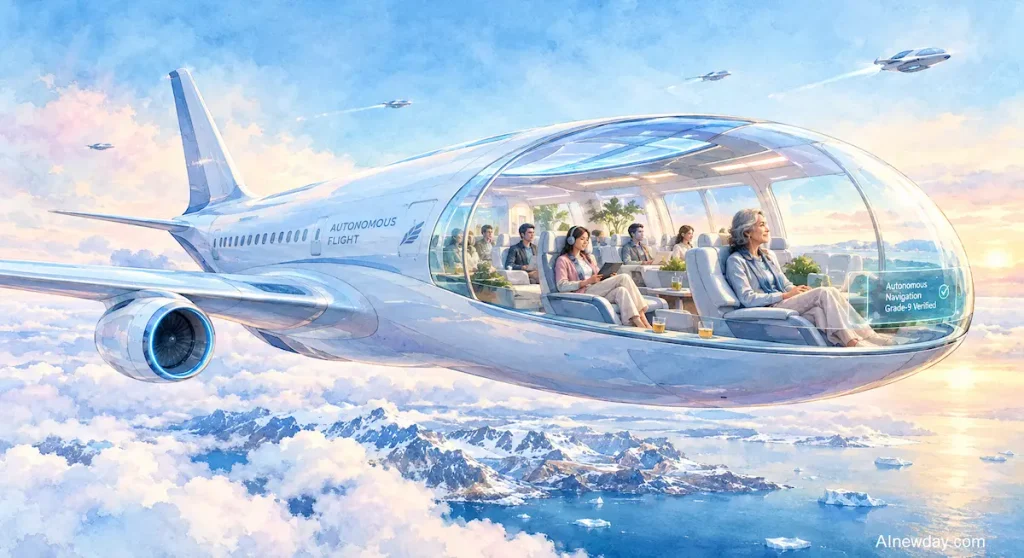
Today, in the autumn of 2075, that cabin architecture is an artifact of engineering history. Where the heavy, armored cockpit door once stood, there is now an unobstructed panoramic observation lounge. Passengers sit in curved linen armchairs, sipping synthetic chamomile, watching the horizon open up directly ahead of them. The nose of the aircraft is entirely transparent, made of molecularly aligned sapphire glass.
Eleanor glanced at the digital flight display glowing softly on her tray table. The aircraft – a sleek, blended-wing-body cruiser powered by cryogenic hydrogen – was adjusting its trajectory by three degrees to avoid an upper-atmosphere convective cell over the North Atlantic. The correction was seamless, executed by a decentralized neural flight network that processes petabytes of atmospheric data per millisecond. There was no captain. There was no first officer. There was not even a single human crew member on board whose job involved mechanical navigation.
To the right of the observation deck, a small, subtle plaque read: Autonomous Navigation Grade-9 Verified.
For the younger passengers on board, this environment was as unremarkable as an automated subway shuttle or a self-driving elevator. They slept, read, or worked within their spatial computing arrays, completely indifferent to the fact that they were suspended eleven kilometers above a freezing ocean, entirely dependent on a complex web of predictive algorithms. But as the aircraft began its silent, computer-guided descent toward Iceland, Eleanor felt a familiar, lingering contradiction – a delicate knot of absolute safety and profound vulnerability.
We have achieved the most efficient, accident-free era in human transit history. Why, then, does the empty nose of the airplane still feel like a quiet surrender?
Returning to the Present: The Real Signals of Autonomy
To understand how Eleanor found herself looking through the nose of a pilotless airliner over Greenland, we have to look backward to the early decades of the twenty-first century. The fiction of tomorrow is almost always built from the mundane engineering bottlenecks and corporate ledgers of today.
When we look at the contemporary aviation landscape, the concept of a completely uncrewed commercial flight looks less like an inevitability and more like a regulatory battlefield. In fact, current statutory frameworks are deliberately tightening their grip on the traditional model. For instance, landmark aviation legislation established a binding requirement that every commercial passenger flight must operate with a minimum of two qualified, fully rested pilots on the flight deck at all times. This statutory firewall effectively stalled efforts by manufacturers to introduce Extended Minimum Crew Operations (eMCO) or Single-Pilot Operations (SPO) in major consumer corridors.
Yet, if we look beneath the surface of defensive legislation, the technological signals are flashing in the opposite direction. The aviation industry is experiencing an acute, structural demographic crisis: global pilot shortages are projected to squeeze regional and international airlines heavily. Human labor in the cockpit is becoming one of the highest operational cost variables, driving intense commercial pressure to innovate.
Autonomy is not entering the aviation world through the front door of major passenger airlines; it is creeping in through the logistics sector and urban air mobility networks. Consider these three foundational shifts currently underway:
- The Regional Cargo Proving Grounds: Autonomous flight control developers are aggressively targeting uncrewed cargo flights. Systems like the Merlin Pilot are designed to integrate into existing cargo fleets, managing system monitoring, flight controls, and communication from takeoff to touchdown. By testing pilotless technologies on regional freight routes, the industry avoids public passenger anxiety while gathering millions of hours of operational safety data.
- The Urban Air Mobility (UAM) Scaling: Short-range passenger flight is already transitioning away from human piloting. Companies like EHang have successfully completed certification stacks for pilotless passenger flights under regulatory bodies like China’s CAAC. Concurrently, massive capital investments – including Beta Technologies’ multi-billion-dollar market valuations and Boeing’s strategic alignment with autonomous eVTOL (electric Vertical Takeoff and Landing) developers like Wisk Aero – demonstrate that the financial infrastructure for pilotless architecture is being solidified.
- Advanced Air Traffic Management (UTM): The sky cannot become autonomous until the air traffic control system does. Real-world testing programs by NASA (such as the AAM National Campaign) and the implementation of federated digital air-traffic architectures in the UK and Europe are early experiments in building a machine-to-machine sky. These systems move away from human radio chatter toward real-time, algorithmic telemetry sharing.
I find that the most profound technological movements do not happen when a single “superintelligence” is invented. They happen when separate, unglamorous systems – a cargo drone certified in New Zealand, a digital license plate standard mandated by the FAA, and an economic crunch in airline hiring – converge.
Autonomous systems are steadily moving from narrow, rule-based automation toward broader, adaptive decision-making capabilities. If these current technological trajectories continue, the question is not whether the technology will be capable of flying an airliner by 2075, but how human culture will adapt to the reality of the empty cockpit.
What Could Change: The Anatomy of a Machine-Guided Sky
If we assume these contemporary signals mature over the next fifty years, the structural landscape of global tourism will undergo a radical optimization.
In a world where flights are pilotless, the fundamental constraints of airline economics dissolve. Human pilots are bound by strict, highly necessary biological limitations: they experience fatigue, require sleep rotation, suffer from sleep inertia during trans-oceanic cruises, and must be paid, housed, and scheduled within rigid operational windows.
By 2075, a pilotless fleet could operate on a model of absolute continuous utility. Without the need for pressurized crew quarters, pilot amenities, or physical cockpit instrumentation, aircraft design will favor radical weight reductions – up to 20 percent according to current aerospace estimates. This weight efficiency translates directly into extended range, lower energy consumption (whether via hydrogen or advanced solid-state batteries), and drastically reduced ticket prices.
Furthermore, the nature of flight delays could change entirely. Today’s aviation grid is highly fragile, susceptible to cascading crew-scheduling failures; if a captain is stuck in a weather delay in Chicago, a flight in Denver is canceled. In an autonomous tourism ecosystem, the “pilot” is a federated software stack, universally distributed across the global fleet. An airplane becomes ready to fly the moment its physical maintenance protocols are cleared by automated diagnostic grids.
Global tourism would likely democratize on a scale never before seen. Remote, historically inaccessible regions – small island communities, high-altitude mountain towns, and deep continental interiors – could be serviced by high-frequency, lower-capacity autonomous shuttles operating twenty-four hours a day, seven days a week. Tourism would shift from a hub-and-spoke system dominated by massive international mega-airports toward a highly fragmented, hyper-personalized direct-transit network.
The Human Question: The Psychology of Algorithmic Trust
What interests me most about this transition is not the thermodynamic efficiency of a hydrogen engine or the computational elegance of a neural flight array. It is the subtle, profound shift in how human beings experience trust, vulnerability, and the act of travel itself.
For over a century, the captain of an aircraft has occupied a unique space in the modern imagination. The pilot is the ultimate archetype of human accountability – a highly trained professional whose own survival is perfectly aligned with the survival of the passengers. If the plane crashes, the pilot dies too. This shared existential stakes-sharing forms an unwritten, deeply comforting psychological contract between the traveler and the flight deck.
When you replace the human pilot with a distributed network of automated flight paths and ground-based supervision teams overseeing multiple flights simultaneously, that contract changes. The algorithm cannot “die.” It has no skin in the game. It does not feel a rush of adrenaline when wind shear hits the runway; it merely executes statistical adjustments based on aerodynamic data.
This introduces a bizarre cultural paradox for the tourist of 2075. Statistically, they are safer than they have ever been. The human errors that account for the vast majority of historical aviation accidents – spatial disorientation, fatigue-induced miscommunication, cognitive overload during crises – have been engineered out of the sky. Yet, emotionally, the act of flying might feel more alienating.
Perhaps the real question we need to ask ourselves is: Are we comfortable trading human accountability for statistical perfection?
Traditional Aviation Model → High Trust / Human Accountability / Biological Risk
(The Cultural Shift)
Autonomous Aviation 2075 → Absolute Trust / Machine Optimization / Zero Human Presence
Hiển thị mãTải biểu đồ xuống dưới dạng SVG (Đồ hoạ vectơ có thể mở rộng)
When travel becomes entirely frictionless, safe, and automated, do we lose a vital piece of the human journey? When Eleanor sits in that observation lounge in 2075, looking out at the open sky through the glass where human beings once fought to keep the plane aloft, her travel is no longer an adventure in the classical sense [Context]. It is a highly optimized utility. The thrill of departure is subtly replaced by the passive consumption of distance.
What Is Real and What Is Speculative: Drawing the Boundary
In speculative journalism, it is vital to separate our logical projections from our imaginative leaps, ensuring we do not misrepresent the structural limits of our present world [Context].
The table below delineates what is verified fact today versus what remains a long-range projection for the year 2075:
What Exists Today (Verified Facts): Commercial flights require a minimum of two human pilots on the flight deck in major jurisdictions. Advanced autoflight systems handle cruise phases, automated landings, and routine navigation under close human supervision.
What Is Being Developed (Active Trials): Autonomous cargo flights on regional routes are undergoing certification trials. Pilotless short-range eVTOL air taxis have received initial commercial airworthiness approvals in selected markets.
What Could Plausibly Happen (2075 Projections): Commercial passenger aviation could become completely uncrewed, with cockpits replaced by passenger observation decks. Global air traffic management could transition to a decentralized, algorithmic network with little or no voice communication.
What Remains Highly Speculative (Unresolved Barriers): Fully self-healing mechanical systems capable of repairing complex structural failures mid-flight without human intervention. Universal international agreement on a single autonomous aviation standard across different geopolitical jurisdictions.
We must acknowledge that bridging the gap between category B (Current Development) and category C (The Future Scenario) requires solving massive, non-technological riddles. The regulatory architecture of global aviation is deliberately conservative, built on decades of hard-learned safety lessons. A single catastrophic cyber-vulnerability or a high-profile failure of an autonomous navigation system could instantly freeze development for a generation. The timeline to 2075 is a plausible trajectory, but it is a path filled with economic, political, and social friction – not a guaranteed destination.
What We Can Do Today: Preparing for an Automated Horizon
The future of tourism described here may feel distant, but the structural habits that will define it are being learned by consumers right now. If you want to understand, navigate, and thrive in this shifting landscape, you do not have to wait for the airliners of 2075. You can take proactive, practical steps today:
- Deconstruct the Hype Cycles: When you read headlines about “self-flying planes,” learn to look for the structural realities. Check whether the technology is being deployed in uncrewed regional cargo operations or passenger flight. Understanding that autonomy scales through freight logistics first will give you a clearer view of long-term investment and career trends in transportation and tourism.
- Acquaint Yourself with Algorithmic Workflows: The logic that will run an airliner in 2075 is fundamentally similar to the predictive systems running today’s logistics, ride-sharing, and automated transit grids. By learning to operate alongside automated systems in your everyday life – understanding when to trust an automated recommendation and when to apply critical human oversight – you are training the exact cognitive flexibility that the future ecosystem will demand.
- Cultivate Human-Centric Travel Skills: As transportation tech becomes more automated, the mechanical aspects of travel will commoditize. The value of human tourism will increasingly reside in things that cannot be scaled by code: cross-cultural empathy, deep local contextual knowledge, creative storytelling, and spontaneous human connection. Focus on developing these organic skills if you work within the hospitality, travel, or creative industries.
The Final Perspective: Looking Through the Glass
We will likely never know with absolute certainty if Eleanor will ever sit in row 14 of that blended-wing cruiser, looking out through a sapphire-glass nose at the cold expanses of the North Atlantic [Context]. The future has an unpredictable habit of bending around geopolitical shifts, resource resource constraints, and the fickle nature of human public opinion.
But the real value of examining a pilotless sky in 2075 isn’t about predicting the exact configuration of an airplane nose [Context]. It is about recognizing that we are already living in the early chapters of that transformation.
Every time we check into a flight using a digital facial scan, every time we ride an uncrewed airport shuttle between terminals, and every time we trust an algorithm to map our driving routes across a crowded city, we are quietly laying the psychological bricks for the world of 2075.
The cockpit is not emptying all at once. It is emptying slowly, one automated system, one optimized ledger, and one quiet acceptance at a time. When the future finally arrives, it won’t shock us with its strangeness. It will surprise us by how completely ordinary it feels.

A technology enthusiast based in An Giang, Vietnam. As the creator of AINewDay, I love exploring AI developments and turning complex tools into practical, everyday workflows. Follow my hands-on experiences, useful prompts, and creative insights to make your daily life more productive with AI.
