

The Quiet Theater of 2140
The air inside Operating Theatre 7 at the New Kyoto Metropolitan Health Hub does not smell of antiseptic or singed flesh. It smells faintly of ozone and dried green tea.
Dr. Elena Vance sits in an ergonomically molded chair in the corner of the room, her hands resting loosely on her lap. She is sixty-two, a veteran thoracic specialist, but her scrubs are completely dry. She is not wearing sterile gloves. She is holding a ceramic mug of warm broth.
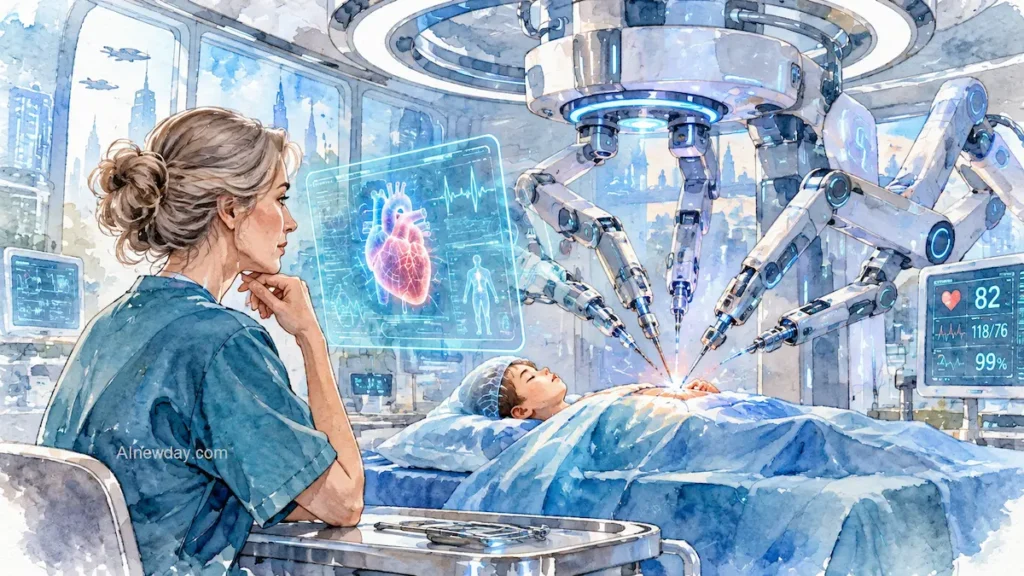
In the center of the room, suspended over a three-year-old child named Leo, is a structural lattice of carbon-fiber arms known colloquially as the Weaver. The child has a complex congenital heart defect – a malformed coronary artery buried deep within embryonic muscle tissue that, a century ago, would have required a grueling eight-hour open-chest procedure with a thirty percent mortality rate.
The room is silent except for the rhythmic, sub-audible hum of localized cooling fans. The Weaver moves with a fluid grace. Its silver tips, equipped with micro-lasers and molecular adhesive applicators, do not jitter. They do not tire. They do not operate based on the individual memory of a single human physician.
Instead, the system is executing an operative strategy synthesized roughly four minutes before the first incision. It analyzed Leo’s real-time, cell-by-cell structural map, cross-referenced it with ninety-four million historical surgical outcomes archived across the global medical cloud, and simulated the entire procedure seven hundred times in a digital twin environment before touching the child’s skin.
Dr. Vance watches a transparent, volumetric display floating to her right. The screen does not show complex code or flashing red warning signs. It displays a simple, predictive timeline. Every three seconds, a soft green pulse indicates that the mechanical execution aligns with the anticipated cellular response.
Her role during this six-minute procedure is profoundly different from that of her twentieth-century predecessors. She is not cutting, suturing, or clamping. She is an algorithmic auditor. She is the ethical anchor. If the Weaver encounters a biological anomaly – a structural mutation completely absent from the global dataset – the system will pause, and Vance will be required to make a choice: allow the machine to improvise within a statistical safety margin, or abort the procedure entirely.
As the machine applies the final layer of bio-synthetic dermal sealant, Leo’s heart rate stabilizes perfectly at eighty-two beats per minute. The Weaver retracts into the ceiling. The entire event took less time than it takes Vance to finish her broth.
She stands up, walks over to the sleeping child, and gently touches his forehead. The surgery was executed with a microscopic precision no human hand could easily replicate. Yet, as Vance looks at the empty space where the machine just operated, she experiences a familiar, lingering sensation – a mixture of profound gratitude and a strange, quiet disorientation.
She is the head of surgery, but she has not touched a scalpel in fifteen years.
This scenario raises an uncomfortable, vital question for those of us living more than a century earlier: When the physical mastery of medicine is entirely outsourced to autonomous intelligence, what exactly happens to the human doctor?
Returning to the Present: The Signals in the Static
It is easy to dismiss Dr. Vance’s morning in 2140 as pure science fiction, a cinematic fantasy detached from the realities of modern medicine. But if we step back from the distant future and look closely at the laboratory breakthroughs, corporate investments, and clinical trials happening around us today, we can see that the foundational bricks of this future are already being laid.
What exists today that makes this level of automation imaginable? We must look at the convergence of three distinct technological movements: the evolution of cognitive AI agents, the refinement of robotic surgery, and the development of real-time digital twins.
First, let us examine the shift in how artificial intelligence processes information. Generative AI is rapidly moving past the stage of simple text generation or static image recognition. Today, researchers are building autonomous AI agents – systems capable of analyzing complex, multi-modal data streams, formulating multi-step strategies, and executing tasks over prolonged periods without constant human prompting. In clinical contexts, primitive forms of these systems are already being used to analyze radiology scans, predict patient deterioration hours before it happens, and comb through millions of medical journals to suggest rare diagnoses.
Second, the mechanical execution of surgery is becoming increasingly decoupled from the direct, physical movements of human fingers. Current robotic-assisted surgery platforms, which have been standard in operating rooms for over a decade, still rely entirely on a human surgeon sitting at a master console, manipulating joysticks to move instruments inside a patient. However, the software running underneath these machines is evolving. Modern upgrades now include features like automated suturing guidance, real-time tissue tracking, and structural boundary alerts that prevent a surgeon from accidentally nicking an artery.
The leap from human-controlled robotics to semi-autonomous intervention is no longer theoretical. A landmark study published by researchers at Johns Hopkins University demonstrated the capabilities of the Smart Tissue Autonomous Robot (STAR). In peer-reviewed trials, the STAR system successfully performed complex laparoscopic anastomosis – the reconnection of two ends of an intestine – on soft tissue in animal models entirely on its own. According to the published findings, the robot’s autonomous execution resulted in significantly higher consistency and precision than seasoned human surgeons, proving that machines can adapt to the unpredictable shifts of living tissue without real-time human intervention.
Concurrently, research teams at institutions like Imperial College London have been pioneering the integration of machine learning algorithms with tactile, haptic feedback systems. Their published work explores how surgical robots can “feel” the structural boundaries between healthy tissue and malignant tumors, providing a mathematical baseline for autonomous physical decision-making.
Finally, we are seeing the early days of spatial computing and biological modeling merging into what engineers call “Digital Twins.” Today, advanced cardiac centers can take a high-resolution MRI of a patient’s heart and create a virtual three-dimensional model on a computer screen. Surgeons use these models to practice difficult cuts before entering the operating room.
When we observe these three independent signals – cognitive AI agents capable of long-term planning, robotic systems capable of autonomous physical execution, and high-fidelity biological modeling – we are looking at the raw ingredients of Dr. Vance’s Weaver.
I find that the most compelling aspect of this technological trajectory isn’t the individual advancement of any single tool, but how they might eventually interact. We are not just building better tools for doctors; we are building an autonomous ecosystem that could eventually challenge the traditional physical skill set of a doctor.
What Could Change: The Unbundling of Clinical Labor
If these contemporary technological signals continue to mature and intersect over the next several decades, the nature of healthcare work will undergo a profound structural transformation. To understand what this means, we must look at how the role of the medical professional could be unbundled and redistributed.
In today’s world, becoming a surgeon requires an extraordinary combination of two distinct types of human excellence: cognitive mastery and physical dexterity. A top-tier surgeon must possess a vast encyclopedic memory of anatomy, pathology, and pharmaceutical interactions, while simultaneously maintaining the rock-steady hand-eye coordination of an elite craftsman. It takes over a decade of intense, high-stress training to fuse these two skill sets into a single human brain.
In a highly automated future, some futurists forecast that these two requirements might be permanently severed.
The physical craftsmanship – the steady hand, the muscle memory required to navigate a needle through microscopic tissue, the split-second tactile adjustments required when a blood vessel ruptures – could be handled primarily by autonomous mechanical systems. A machine does not suffer from hand tremors due to age. It does not experience cognitive fatigue after a fourteen-hour shift. It does not have an off-day because it slept poorly the night before.
Consequently, some speculative tech analysts argue that the physical training of a medical professional might diminish or alter dramatically. It is conceivable that future medical curricula could reduce the emphasis on manual surgical techniques. However, we must remain cautious with this assumption. Even if a robot executes the physical incision, a human doctor’s deep anatomical knowledge and physical practice could remain vital. Without an intimate, tactile understanding of the human body, a physician might lose the capacity to judge whether a machine’s physical execution is structurally sound. The training may not disappear; instead, it might evolve into a form of high-level oversight.
If this partial automation is realized, it could drastically democratize access to high-end medical care. Today, if you require a highly specialized, incredibly rare brain surgery, your survival often depends on your wealth, your geographical location, and whether you can get onto the schedule of one of the few dozen human beings on Earth who have mastered that specific procedure.
If that mastery can be digitized, validated, and distributed across a global cloud network, a small community clinic in a developing nation could theoretically deploy a highly advanced level of surgical precision. The systemic inequality of access to physical surgical talent could be significantly reduced.
The Human Question: The Erasure of Clinical Intuition
Yet, as an observer of how human beings interact with technology, I believe it is critical to look beneath the utopian promise of universal healthcare. What concerns me most about this scenario is not the risk of mechanical malfunction, but the gradual, permanent erosion of human clinical intuition.
Medical intuition is a real, albeit difficult to quantify, phenomenon. Ask any seasoned emergency room doctor or trauma surgeon, and they will tell you about times they made a life-saving decision based on a “feeling” they couldn’t immediately explain. They noticed a subtle gray tint to a patient’s skin, a specific scent in the room, or a minute asymmetry in how a chest was rising. This is the human brain’s capacity for subconscious pattern recognition, built over decades of direct, messy, sensory immersion in human suffering.
What happens when we introduce a generation of doctors who have spent their entire careers sitting behind screens, monitoring predictive dashboards like Dr. Vance?
If a human physician rarely holds a scalpel, rarely feels the resistance of healthy tissue versus diseased tissue with their own fingers, and rarely experiences the raw, visceral panic of a sudden, unexplained hemorrhage on the table, their biological pattern-recognition system might atrophy. They could become entirely dependent on the machine’s interpretation of reality.
This creates a dangerous cognitive vulnerability. If the autonomous system encounters a truly novel biological anomaly – perhaps a fast-moving mutation or an unprecedented physiological reaction to a new synthetic drug – it may output an error code or a flawed recommendation. A human doctor who lacks deep, physical intuition will have no internal reference frame to challenge the machine. They might be forced to trust the algorithm blindly, transforming their role from an active, authoritative healer into a passive observer.
Furthermore, we must confront the psychological impact on the patients themselves. Healing is fundamentally an interpersonal act. When we are sick, vulnerable, and facing our own mortality, we do not merely seek a mechanical correction to our biological hardware; we seek human connection, empathy, and the reassurance that another human being is taking responsibility for our life.
If the operating room becomes a completely black-boxed automated system, where the human doctor acts merely as an IT administrator checking boxes on a screen, we risk turning medicine into a cold, transactional industry. We might conquer the physical illnesses of the body, only to deepen the psychological alienation of the patient.
Distinguishing Fact from Long-Range Speculation
To maintain our intellectual honesty, we must draw a sharp, clear boundary between what we can genuinely verify today and what remains an imaginative thought experiment or unconfirmed forecast. It is easy to write a compelling narrative about autonomous surgeries, but we must break down the structural realities of these claims.
The Spectrum of Clinical Automation Mechanisms
- Level A: What Exists Today
- Robotic surgical consoles controlled manually by humans.
- AI diagnostics for static imaging across radiology and oncology.
- Pre-operative 3D modeling of specific patient organs.
- Johns Hopkins University STAR experiments on animal models for soft-tissue surgery.
- Level B: What Is Being Developed
- Semi-autonomous suturing and tissue-tracking algorithms.
- Haptic feedback integration spearheaded by institutions like Imperial College London.
- Dynamic, multi-modal AI agents capable of autonomously handling complex medical records.
- Level C: What Is Forecasted / Possible
- Potential automation of routine, highly standardized surgeries, such as simple appendectomies, by mid-century.
- Medical training shifting heavily toward systems management, oversight, and algorithmic auditing.
- Level D: What Remains Highly Speculative
- Unsupervised robotic systems handling chaotic, unpredictable trauma surgery without any human intervention.
- Molecular-level autonomous reconstruction, such as the imagined 2140 Weaver system.
- Global legal frameworks treating artificial intelligence as an independent, liable entity.
When we look at this map, we realize that the vision of 2140 relies on massive, unproven breakthroughs across multiple disciplines.
For instance, the assumption that routine surgeries will be fully automated by the middle of this century is a speculative projection, not a confirmed scientific consensus. Current robotic platforms are excellent at operating on rigid, predictable structures like bones during orthopedic surgery. However, operating autonomously on soft tissue – like the brain, intestines, or lungs – is an entirely different engineering challenge. Soft tissue moves, shifts, deforms, and leaks fluid unpredictably every time it is touched. While the STAR system proved it is possible in controlled animal trials, scaling that to human variability across diverse pathologies remains an open research question.
Furthermore, the legal, economic, and ethical infrastructure required for autonomous healthcare does not exist. If an autonomous machine makes an error that results in permanent injury or death, who bears the liability? The software developer? The hardware manufacturer? The hospital administration? Or the human auditor who failed to press the override button?
Until our legal systems can answer these questions, true autonomy will likely remain confined to highly monitored clinical experiments, regardless of how advanced the underlying code becomes.
What We Can Do Today: Building the Hybrid Professional
We cannot know with absolute certainty if the Weaver will ever exist, or if Dr. Vance’s silent operating room will become a reality. However, we can clearly see that the tide of medical automation is rising. We do not need to wait until 2140 to adapt; the shift in how healthcare professionals must work is already underway.
For young medical professionals, students, and healthcare administrators entering the field today, the path forward requires a radical rethinking of career longevity. Preparing for this future does not mean resisting the integration of technology, nor does it mean capitulating to it completely. Instead, it requires the intentional cultivation of a hybrid skill set.
First, clinicians must actively develop algorithmic literacy. It will no longer be enough to understand the biological mechanisms of human disease; doctors must understand how data systems function, how machine learning models are trained, and how to identify biases and systemic errors within clinical software. The future likely belongs to the medical professional who can act as an effective translator between the raw computing power of data systems and the delicate realities of human biology.
Second, we must place a renewed, aggressive emphasis on the un-automatable aspects of medicine. As data models take over the heavy lifting of diagnostic calculations and procedural planning, the human value of a healthcare worker will be measured by their capacity for deep empathy, complex ethical decision-making, crisis communication, and holistic patient care. Medical schools should place as much institutional value on training students in emotional intelligence, active listening, and philosophical ethics as they currently do on memorizing chemical pathways.
Finally, we must remain vigilant against the temptation of premature reliance. We should use automated tools today to augment our capabilities, to check our work, and to reduce administrative burdens. But we must never allow them to completely replace the hard, uncomfortable work of direct human observation and clinical reasoning. We must maintain our cognitive muscles, ensuring that if the screens ever go dark, the human mind remains entirely capable of healing.
The Horizon of 2140
As we look out toward the far horizon of the twenty-second century, we are not looking at a predetermined destination, but at a reflection of the choices we are making in our clinics and laboratories today.
The story of Dr. Vance and young Leo is not a prophecy. It is a thought experiment designed to expose the delicate balance between mechanical perfection and human identity. Technology may eventually grant us the power to remove the fallible, trembling human hand from the operating theater, achieving a level of safety and precision that seems miraculous by today’s standards.
But as we build that future, we must remember that the true essence of medicine has never been found solely in the sharpness of the blade or the efficiency of the stitch. It lives in the sacred, fragile space where one human being looks at another who is suffering and says, I am here, I am paying attention, and I am taking responsibility for you.
As we hand the tools of healing over to our algorithms, our ultimate challenge will be ensuring that we do not accidentally lose the healer along the way.

A technology enthusiast based in An Giang, Vietnam. As the creator of AINewDay, I love exploring AI developments and turning complex tools into practical, everyday workflows. Follow my hands-on experiences, useful prompts, and creative insights to make your daily life more productive with AI.
