

A Mid-Day Review at the High-Orbit Archive
Julian adjusted his collar, though the humidity of the rainforest outside his window couldn’t reach him inside the simulation. To anyone standing in his physical room in Singapore, he was simply sitting still, breathing rhythmically. But within his field of vision, he was walking along a narrow catwalk suspended over the high-orbit atmospheric archives of Neo-Cairo.
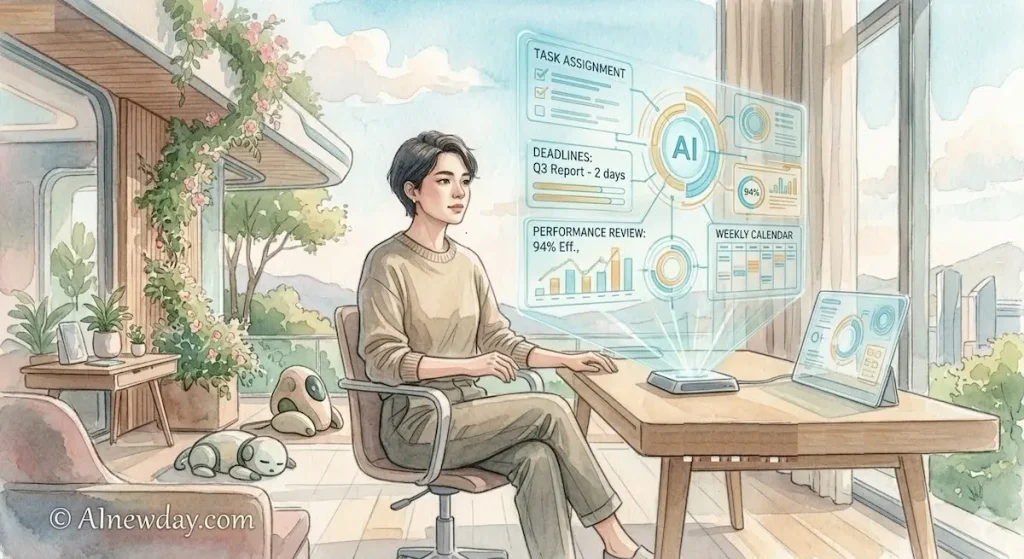
The air in the simulation felt crisp, carrying a faint, synthetic scent of ozone that his neural interface fed directly to his olfactory cortex. It was a small aesthetic choice, a default setting designed to induce focus.
“Julian,” a voice echoed, not through his ears, but as a clean, localized thought at the back of his mind. “The solar radiation anomaly from the Southern Hemisphere data sets has caused a three percent variance in our quarterly atmospheric models. We need to recalibrate the predictive infrastructure for the sub-Saharan agricultural zones.”
The voice belonged to Vesper, the managing entity of Julian’s department. Vesper did not possess a body, nor did it project a human avatar to sit across from Julian at a desk. Instead, its presence was woven into the environment itself—manifesting as a subtle shifting of the light on the catwalk or a soft resonance in the background hum of the archive.
Vesper had been managing this sector for thirty-four years. It knew Julian’s intellectual pacing better than his closest friends did. It knew that if it assigned this task at three in the afternoon, Julian’s cognitive efficiency would drop due to his circadian patterns. Consequently, Vesper had already restructured Julian’s schedule for the following morning, cleared his administrative obligations, and pre-allocated three sub-routines to handle the heavy mathematics.
“I’ve already flagged the anomalies,” Julian replied, speaking aloud into the empty physical room, his words captured and translated instantly into semantic data. “But if we adjust the sub-Saharan model now, we might trigger a false scarcity alarm in the regional logistics network. Did you account for the psychological panic threshold of the local distribution algorithms?”
The ambient light in the archive shifted from a cool blue to a warm amber—a non-verbal signal that Vesper was processing the variable. “An elegant catch, Julian. I am cross-referencing the emotional volatility indexes of those distribution nodes now. Let us table the final adjustment until the regional models sync at midnight.”
Julian walked to the edge of the catwalk, looking down at the swirling digital clouds of the simulated earth below. He did not feel oppressed by Vesper’s oversight. He did not feel the anxiety of an employee staring at a critical manager. Yet, as he watched the data streams pulse through the virtual sky, a quiet, familiar question surfaced. Vesper was efficient, objective, and fundamentally fair. But in a world where the manager optimizes every breath an employee takes to maximize cognitive output, has work ceased to be a human endeavor? Are we still professionals creating value, or have we simply become the organic processors for an administrative intelligence we can no longer fully understand?
Returning to the Present: The Modern Roots of the Digital Workplace
To a professional navigating the corporate landscape today, Julian’s afternoon sounds like a leap into pure science fiction. A century seems long enough to change every rule of human society. However, if we step away from the grand scale of the year 2120 and look closely at the technological landscape today, we can see that the foundations of this distant workplace are already being laid. The future is not a sudden explosion; it is an accumulation of quiet shifts in how we handle data, space, and authority.
Consider how we occupy space. For decades, work required a physical destination—a brick-and-mortar office where bodies were assembled to exchange ideas. Today, that requirement is dissolving. Spatial computing has moved past its early, awkward stages. Devices designed for augmented and virtual reality are proving that high-fidelity digital environments can hold our attention for hours. We are learning to look at screens not as windows we stare into, but as spaces we step inside. The boundary between the physical room and the digital display is becoming increasingly thin.
Simultaneously, the nature of corporate software is shifting from passive documentation to active direction. We have long been accustomed to using tools that wait for our commands. However, modern project management platforms and enterprise systems are beginning to incorporate predictive algorithms. They do not merely store our schedules; they analyze workloads, flag potential delays, and suggest who should handle a task based on past performance.
From Today’s Signals to Tomorrow’s Possibilities
Technologies already emerging in 2026 may point toward very different possibilities a century from now. Spatial computing could evolve into fully immersive workspaces. Predictive AI could become a system for algorithmic management. And early neural-interface research might eventually make communication less about words and more about directly sharing meaning.
At the same time, the evolution of generative AI is transitioning from simple text synthesis toward autonomous, multi-step execution. We are seeing the emergence of independent digital agents that can coordinate with other software systems, make low-level operational decisions, and manage workflows without needing constant human validation. When we look at these converging trends—spatial environments that feel increasingly physical, and software systems that are becoming increasingly autonomous—the concept of an AI manager within a virtual office ceases to look like a random guess. It begins to look like a plausible direction for the corporate world.
The Shift in Authority: Why Algorithmic Management Emerges
If we assume these current signals continue to develop over the next century, the traditional hierarchy of human management could face a fundamental reorganization. Human management, by its very nature, is vulnerable to friction. It is complicated by personal biases, emotional fatigue, miscommunication, and the administrative burden of tracking complex organizational data. An algorithmic managing entity presents an entirely different proposition for a business structure.
An enterprise managed by an advanced system would theoretically operate with unprecedented fairness. An algorithmic boss does not have personal favorites, does not experience bad moods because of external stresses, and does not hold unconscious biases against an employee’s background. It evaluates a professional’s contribution based on objective, multi-dimensional data patterns. It could track systemic bottlenecks across an entire global network in real time, matching individual cognitive strengths with specific corporate needs while monitoring stress markers to prevent individual exhaustion.
Yet, this drive toward total optimization introduces deep questions about human autonomy. If an organization relies on an algorithmic entity to determine roles, project paths, or career progression, the traditional mechanics of human appeal begin to break down. A human manager can understand context that cannot be easily quantified—the personal grief that causes a temporary dip in performance, or the messy, unpolished creative spark that looks like an error on a spreadsheet but leads to a breakthrough.
I find that the most unsettling part of this scenario isn’t the sophisticated nature of the technology itself, but how ordinary it might eventually feel to hand over that authority. What interests me most is not whether a machine can become smart enough to manage a human team, but whether we will become so tired of human corporate politics that we gladly welcome an algorithmic master. By removing the messiness of human relationships from the workplace, we risk turning our professional lives into a flawless, unyielding pipeline where human beings are treated as biological nodes within a vast, self-correcting digital architecture.
Distinguishing Reality from Distant Projection
When we look over a horizon as distant as a century, we must remain intellectually honest about the limits of our current knowledge. It is vital to separate the proven capabilities of today from the long-range thought experiments of tomorrow.
- What Genuinely Exists Today: We have systems that can synthesize vast quantities of business data, draft clear operational reports, and automate complex schedules. We have spatial hardware that allows teams to view data visualizations together in a shared virtual room.
- What Is Currently Under Development: Engineers are building sophisticated multi-agent networks where different AI entities can assign tasks to one another, solve multi-stage software problems, and adapt their communication styles to match human preferences.
- What Is Plausibly Possible: Over the coming decades, it is reasonable to consider that corporate structures might grant administrative oversight to automated systems, allowing algorithms to optimize daily workflows, allocate budgets, and manage remote teams across global digital networks.
- What Remains Highly Speculative: The idea that an artificial entity could possess genuine legal sovereignty, hold ultimate moral accountability for a corporation’s social impact, or experience true human empathy remains entirely in the realm of speculation. A century of development may bring radical shifts in software capability, but we cannot assume these systems will develop actual consciousness or an inner emotional life. Vesper, in this scenario, functions on advanced pattern recognition and behavioral prediction—not genuine human feeling.
From Today’s Signals to 2120’s Possibilities
The technologies we see today may be only early signals of much larger transformations.
Automated data synthesis and workflow tracking could eventually evolve into autonomous management systems capable of coordinating operations with minimal human intervention.
Virtual meeting rooms and digital avatars may become the foundation for seamless, multi-sensory work environments, where physical distance matters far less than it does today.
And today’s wearable stress-monitoring devices could point toward systems that continuously interpret cognitive signals and adjust workloads in real time, changing not only how we work, but how work responds to us.
These are not predictions of what will happen. They are speculative possibilities built from technological signals already visible today.
Restoring the Balance: The Value of the Inexplicable Human
The real value of exploring a distant workplace is not to predict the exact tools we will use, but to re-examine what makes our current work meaningful. If the future involves systems that excel at logic, optimization, and synthesis, then the definition of professional excellence will inevitably have to change.
Perhaps the real question we should ask is not whether we can build an AI boss, but whether we should want one. If we allow algorithms to define every goal, evaluate every metric, and smooth over every professional disagreement, we risk losing the very friction that drives genuine human innovation. Often, the greatest leaps in human business, art, and science do not come from looking at a data set and finding the most logical next step. They come from strange intuitions, accidental mistakes, and emotional convictions that defy algorithmic logic.
An automated system can optimize a path, but it cannot explain why the destination matters to the human spirit. It can manage the resources of a project, but it cannot feel the pride of shared human achievement after a long, difficult endeavor. If the office of the future becomes a flawless virtual space run by an impeccable intelligence, the human professionals within that space must not try to compete with the machine on its own terms. They must preserve the very qualities that the machine cannot quantify: our ability to care about things that do not make logical sense, our capacity for erratic creativity, and our stubborn insistance on finding meaning beyond a productivity metric.
Practical Steps for an Evolving Professional Landscape
We do not have to wait for the next century to begin preparing for a more automated workplace. The shifts that could lead to an algorithmic corporate environment are happening in small increments today. By changing how we interact with technology right now, we can ensure we remain the directors of our careers rather than passive users of automated platforms.
If you want to build a resilient professional profile in an era of increasing automation, consider focusing on these practical approaches today:
- Focus on Structural Logic: Do not simply learn how to operate a single software tool or write a specific prompt. Focus on understanding how data moves through a business, how different systems interact, and where automated steps can fail. The professionals who understand the broader architecture of a system will always be needed to oversee it.
- Strengthen Non-Quantifiable Skills: Double down on capabilities that cannot be easily turned into data points. Cultivate deep empathy, cross-cultural understanding, complex negotiation skills, and ethical reasoning. These human-centric attributes are difficult for an optimization algorithm to replicate or manage.
- Practice Intellectual Independence: Use modern automated tools to handle routine drafting, scheduling, and data sorting, but do not let them dictate your strategic conclusions. Force yourself to question automated recommendations and look for angles that a standard pattern-recognition system might miss.
- Build Adaptability into Your Routine: Get comfortable working across different digital environments, asynchronous communication channels, and evolving collaborative spaces. The more flexible you are with how and where you work today, the less disruptive future shifts in spatial technology will be.
We may never stand on a virtual catwalk over Neo-Cairo, listening to a thought-based update from an invisible manager. That specific future remains an imagined scenario among many possibilities. But by looking at that potential world, we can see our current workplace with greater clarity. We can see that the tools we choose to build today, and the authority we choose to give them, will quietly shape the world that future generations will log into tomorrow.
