

The Ghost in the Grocery Aisle.
The fluorescent lights of the neighborhood market hummed with a quiet, familiar frequency. Elena stood in front of the organic produce section, her fingers hovering over a crate of heirloom tomatoes. To anyone walking past, she was simply a sixty-year-old woman completing an ordinary Tuesday evening chore. But behind her eyes, a silent choreography of data was unfolding.
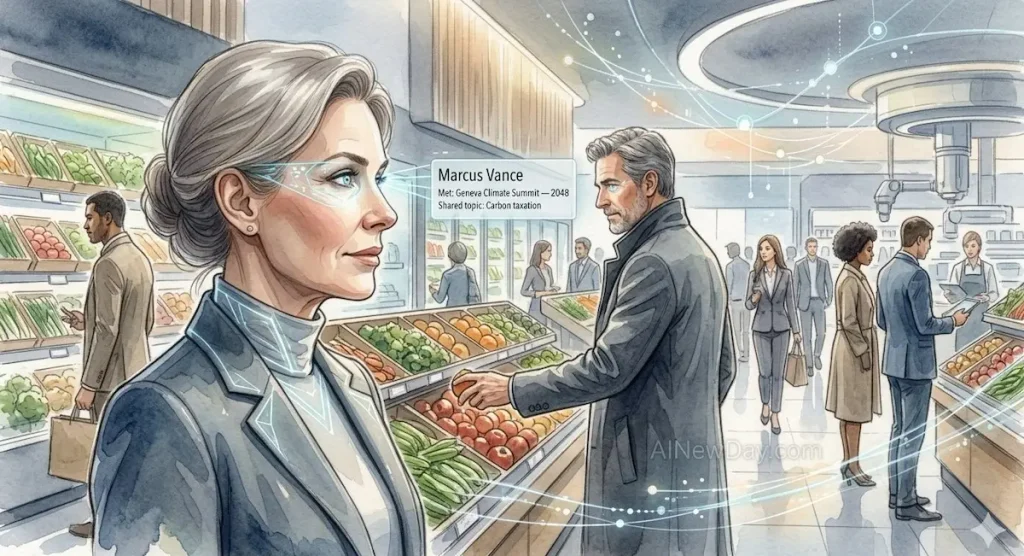
A man in a charcoal jacket stepped into her peripheral vision, reaching for a bunch of basil. Instantly, a soft, translucent amber ring materialized in the lower-right quadrant of Elena’s field of vision. It didn’t flash or beep; it drifted into view with the subtlety of smoke.
Marcus Vance, the textual overlay read, rendered in a clean, minimalist typeface that seemed to float three feet in front of her. Met October 14, 2048, at the Geneva Climate Summit. You discussed carbon taxation frameworks over espresso. He has a slight tremor in his left hand from an old sporting injury. His eldest daughter just completed her residency at Johns Hopkins.
Elena caught herself before her gaze lingered too long. She turned, offering a practiced, warm smile. “Marcus,” she said, her voice natural, betraying none of the internal digital retrieval that had occurred a fraction of a second prior. “It’s been ages. How is your daughter doing at Johns Hopkins?”
Marcus blinked, his own smart contact lenses subtly adjusting focus as they registered Elena’s facial geometry, pulling up his own encrypted log of their shared past. A look of profound, albeit technologically manufactured, warmth washed over his face. “Elena! Incredible that you remember. She just finished her first rotation last week.”
They spoke for four minutes about medicine, the unusual autumn heat, and the changing flavor of mass-produced agriculture. Throughout the interaction, Elena’s lenses quietly logged the event: Encounter verified. Location: Sector 4 Cooperative Market. Duration: 4m 12s. Mood index: Cordial.
When Marcus walked away, the amber text dissolved into the background of reality, leaving Elena alone with the tomatoes. She stood still for a moment, feeling a familiar, faint hollow sensation in her chest. She had remembered his daughter’s career, his favorite coffee, and the exact year they met. Yet, as she looked at her basket, she realized she couldn’t quite recall the genuine emotional texture of that Geneva afternoon in 2048. The data was immaculate, but the memory felt like a photocopy of a photocopy.
This is the strange, quiet reality of the late twenty-first century. We have conquered the human tragedy of forgetting, but in doing so, we have fundamentally altered what it means to remember.
Returning to the Present: The Signals in the Room
To look at Elena’s world from the vantage point of today is to realize that the components of her smart contact lenses are not born from pure science fiction. They are already here, scattered across research laboratories, corporate roadmaps, and early-stage consumer hardware.
If we strip away the futuristic narrative, the “always-on social assistant” relies on the convergence of three distinct macro-technological movements that are accelerating right now:
The Shrinking of Spatial Computing
We are currently witnessing a deliberate migration of hardware from bulky headsets to lightweight eyewear. The foundational steps were taken through enterprise-grade spatial computing rigs, which proved that digital objects could be anchored to physical environments with millimeter precision. Today, the focus has shifted toward smart glasses equipped with micro-projectors and embedded cameras. Companies are actively solving the thermal and battery constraints required to keep display engines running within frames that look indistinguishable from ordinary reading glasses. The leap from a glass frame to a biocompatible contact lens is a matter of manufacturing scale and materials science, not theoretical physics.
Multimodal AI Agents and Continuous Context
Today’s generative AI is undergoing a profound transformation. We are moving away from the “static box” model – where a user types a prompt and waits for an answer – toward autonomous AI agents capable of continuous, multimodal perception. Current models can already process live video feeds, analyze vocal inflections, and maintain incredibly long context windows that span millions of words. In laboratories today, developers are experimenting with “egocentric AI” – systems designed to look through a user’s eyes, index their surroundings in real-time, and build a semantic map of every object, text, and face they encounter.
Biocompatible Electronics and Smart Optics
The field of optoelectronics has already moved past the drawing board. Researchers have successfully embedded micro-LED displays, microscopic wireless antennas, and biocompatible batteries into flexible, wearable contact lenses. Early medical applications of these lenses focus on monitoring intraocular pressure for glaucoma patients or tracking glucose levels via tear fluid. The transition from medical diagnostics to consumer heads-up displays is the clear, long-term trajectory of these experimental platforms.
When we observe these three distinct threads – the miniaturization of displays, the rise of contextual AI agents, and the reality of smart contact lenses – it becomes clear that Elena’s world is a plausible projection. It is an exploration of what happens when these technologies inevitably collide and become mass-market consumer realities.
Present-Day Signals
│── Lightweight Smart Glasses & Micro-LED Displays
│── Multimodal Egocentric AI Agents (Real-time indexing)
└── Medical Smart Contact Lenses (Glucose/Pressure tracking)
▼
The Convergence Trend
Continuous, passive visual analysis paired with a perpetual personal database.
▼
The Speculative Future (2070)
Omnipresent social assistance where forgetting an acquaintance becomes impossible.
What Could Change: The End of the Blank Slate
If this trajectory continues and society embraces all-day contextual eyewear, the social fabric of human interaction will experience a fundamental rewrite. The most immediate casualty of this era will be the concept of the “blank slate.”
For the entirety of human history, walking into a room full of strangers meant navigating a space of mutual anonymity. Relationships began with a baseline of zero shared data; trust, affinity, and understanding were built incrementally through conversation. In a world governed by persistent visual indexing, anonymity becomes a luxury of the past.
Imagine attending a professional gathering or a neighborhood block party in 2070. As you scan the crowd, your lenses perform a passive, instantaneous audit of every face. The system cross-references the live video feed against your personal historical logs, encrypted corporate databases, and public social ledgers. The people around you are no longer mysteries; they are walking dossiers.
This shift would alter the power dynamics of everyday conversation. The traditional social friction of “What was their name again?” or “Where do I know them from?” evaporates. In its place emerges an intense, hyper-efficient form of socialization. Conversations could become instantly optimized. You would skip the awkward small talk and dive immediately into topics predefined by the AI as mutually agreeable or highly relevant to your past interactions.
However, this efficiency introduces a strange paradox. When an algorithm curates the context of your interactions, the potential for serendipity shrinks. We might find ourselves trapped in a loop of historical optimization, speaking only to the people the system flags as high-value connections, and discussing only the topics that have been digitally preserved. The messy, unpredictable joy of discovering a shared connection by chance could be replaced by a sterile, pre-calculated choreography.
The Human Question: The Burden of Total Recall
I find the most unsettling aspect of this speculative future isn’t the sophisticated hardware itself, but how rapidly we might let it erode our internal capacity for emotional presence.
Human memory is inherently flawed, and for a very good reason: it is designed to discard the noise so we can retain the signal. We forget the mundane details of what someone wore, the exact date of a casual meeting, or the trivial arguments of a decade ago, allowing our minds to preserve the emotional essence of a relationship. Forgetting is not a software bug; it is a vital human adaptation that enables forgiveness, growth, and cognitive survival.
What happens when we outsource this delicate biological process to an external silicon layer?
When your contact lenses remember everyone you have ever met, the past ceases to be a fluid, subjective narrative. It becomes a rigid, unyielding archive. If you run into an estranged friend, an old romantic partner, or a former business associate with whom you parted on poor terms, the system will instantly revive the exact data points of your final interaction. The passage of time will no longer soften the edges of our memories, because the technology will keep those edges perpetually sharp.
Furthermore, we must confront the psychological dependency that this creates. If a generation grows up relying on a visual overlay to navigate social dynamics, what happens to their innate emotional intelligence? If the lens tells you when someone is lying based on micro-expressions, or suggests the exact empathetic phrase to utter when an acquaintance is grieving, do you genuinely care, or are you simply reading a script?
The real danger here is the commodification of human connection. We risk turning our social circles into databases to be managed, rather than communities to be felt. The ultimate irony of an AI that helps you remember everyone is that it might inadvertently prevent you from truly knowing anyone.
What is Real and What is Speculative
In analyzing a future as complex as 2070, it is critical to maintain a strict boundary between verified contemporary capability and imaginative extrapolation. The goal of speculative journalism is not to present prophecy as fact, but to examine the space between them.
To maintain editorial integrity, we must look at the four distinct levels of this technological landscape:
What Exists Today
- Lightweight smart glasses equipped with front-facing cameras and directional audio that can stream video to external processors.
- AI models capable of performing facial recognition and object detection on live video feeds within closed cloud environments.
- The deployment of multi-million token context windows, allowing AI to hold massive volumes of text and conversation history in short-term operational memory.
What is Being Developed
- Prototypes of flexible, biocompatible contact lenses featuring single-pixel displays and integrated medical sensors.
- Advanced egocentric AI frameworks designed to process continuous video from wearable devices to build contextual search engines for a user’s daily life.
- Low-latency edge computing infrastructure aimed at processing complex AI tasks directly on localized devices without relying entirely on remote data centers.
What Could Plausibly Happen
- By the mid-to-late 21st century, consumer eyewear could reach a form factor where advanced augmented reality overlays are comfortable enough for all-day use.
- Societal norms might shift to accept passive, real-time data indexing in professional and public environments, viewing it as a necessary tool for productivity and safety.
What Remains Highly Speculative
- The technical viability of squeezing a high-resolution display, a multi-spectrum camera, a high-speed wireless transceiver, and a safe, long-lasting power source into a microscopic, flexible lens that can sit comfortably on a human cornea for sixteen hours a day.
- The legal and regulatory assumption that individuals will be allowed to continuously record and index the facial data of private citizens in public spaces without severe privacy liabilities or universal legislative bans.
THE SPECTRUM OF REALITY: CURRENT REALITY – Smart glasses with cameras + cloud-based facial identification → ACTIVE DEVELOPMENT – Biocompatible diagnostic lenses + egocentric AI context engines → PLAUSIBLE FUTURE – All-day consumer AR eyewear with automated social dossiers → HIGHLY SPECULATIVE – High-resolution displays & cameras inside a self-powered contact lens.
What We Can Do Today: Building Cognitive Autonomy
We do not have to wait until 2070 to decide how we will engage with the technology of memory. The foundational choices are being made right now, in how we interact with the early-stage digital assistants, notification engines, and smartphones that dominate our daily routines.
If we wish to prepare for a future where external devices attempt to manage our minds, we must cultivate specific habits of cognitive autonomy today:
- Practice Unassisted Recall: Resist the urge to instantly search for every forgotten name, trivia point, or historical date on your smartphone. Allow your brain to navigate the discomfort of temporary forgetfulness; exercise the biological pathways of retrieval.
- Establish Digital-Free Interaction Enclaves: Create spaces in your personal and professional life where wearable technology and screens are entirely absent. Conduct meetings, dinners, and family conversations with the explicit understanding that the interaction is being recorded only within the minds of the participants.
- Audit Your Dependence on Automated Insights: When your current email client or messaging application suggests a generic, automated reply like “Sounds great, thanks!”, pause before clicking it. Take the extra five seconds to formulate a response that carries your unique linguistic cadence and genuine intent.
- Understand the Mechanics of Contemporary Tools: Educate yourself on how modern computer vision and data logging operate. By understanding how an algorithm converts an image into a vector or a conversation into a semantic embedding, you demystify the technology, allowing you to see it as a flawed mathematical tool rather than an omniscient authority.
The Persistent Unpredictability of Tomorrow
The purpose of envisioning a world where our eyes are tethered to an omniscient digital archive is not to declare that this future is inevitable. The socio-technical landscape of 2070 will be shaped by variables we cannot accurately calculate today: sweeping privacy legislation, cultural counter-movements that reject all-day surveillance, or economic bottlenecks in advanced manufacturing.
Elena’s interaction in the grocery aisle may never happen exactly as described. The smart contact lens might remain an elusive engineering dream, replaced instead by elegant audio interfaces or non-invasive neural implants.
But the value of the exercise remains. By examining how easily we could convert our messy, biological human encounters into clean, searchable data fields, we are forced to look at our current world with fresh eyes. We begin to see that our flaws – our awkward pauses, our shared moments of forgetfulness, and our reliance on genuine emotional intuition rather than a digital script – are not inefficiencies to be engineered away. They are the very things that make a Tuesday evening in an ordinary market worth remembering in the first place.

A technology enthusiast based in An Giang, Vietnam. As the creator of AINewDay, I love exploring AI developments and turning complex tools into practical, everyday workflows. Follow my hands-on experiences, useful prompts, and creative insights to make your daily life more productive with AI.
