

The Tuesday Review.
The glass wall of Arthur’s workspace overlooking Neo-Manchester didn’t shimmer with holographic displays, nor did it pulse with neon neon-ambient light. It was just glass, smudged slightly at elbow height. He sat in an ergonomic mesh chair that differed very little from the office chairs of the early 2000s, holding a ceramic mug of lukewarm chicory blend. The future of work, it turned out, was surprisingly quiet.
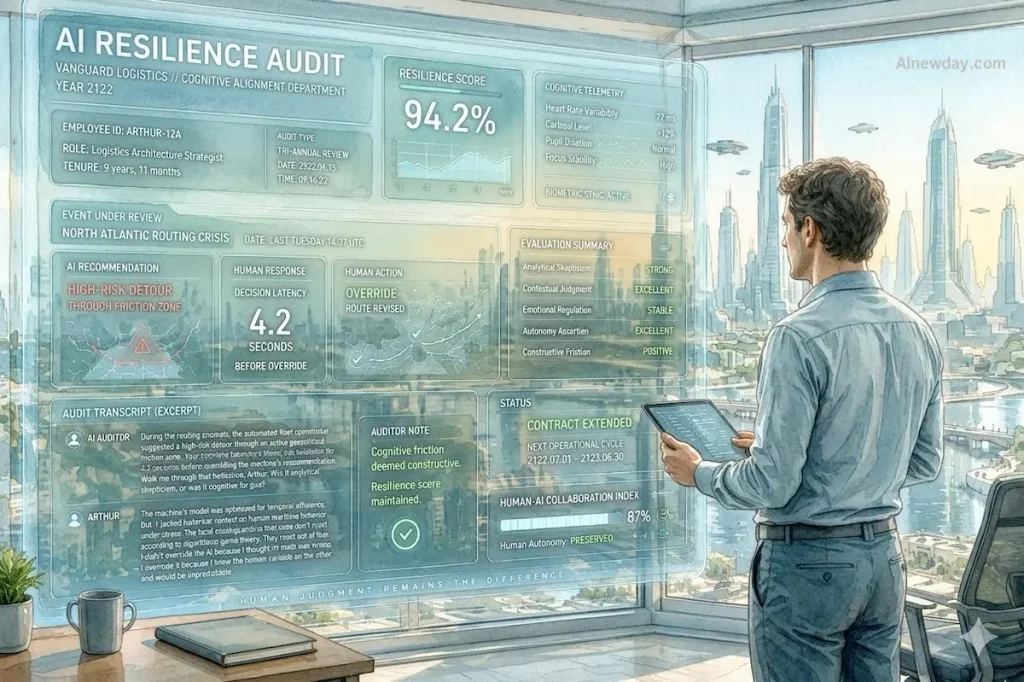
At 9:14 AM, his terminal hummed – a gentle, acoustic chime designed to mimic a physical tuning fork. It was time for his tri-annual Resilience Audit with the Department of Cognitive Alignment at Vanguard Logistics.
Arthur wasn’t interviewing for a new job; he had been a Logistics Architecture Strategist at Vanguard for nearly a decade. But in the year 2122, the concept of a static job interview was a relic of the industrial past. Hiring had become an ongoing, continuous state of evaluation.
“Good morning, Arthur,” a voice said from the directional audio node embedded in his desk. It wasn’t robotic, nor was it overly cheerful. It possessed the slightly gravelly, authentic cadence of a fifty-year-old human HR director, modeled after a real executive who had retired forty years prior. “We are reviewing your symbiotic metrics for the last quarter. Specifically, your latency response during the North Atlantic routing crisis last Tuesday.”
Arthur took a slow sip of his drink. His palms weren’t sweating, but his internal biometric monitor – a subtle patch behind his left ear – registered a minor spike in cortisol. The audit wasn’t checking whether Arthur could code, nor was it testing his mathematical aptitude; the corporate neural network handled millions of calculations per microsecond. Instead, the system was measuring his AI Resilience.
“During the routing anomaly,” the voice continued, “the automated fleet coordinator suggested a high-risk detour through an active geopolitical friction zone. Your cognitive telemetry shows you hesitated for 4.2 seconds before overriding the machine’s recommendation. Walk me through that hesitation, Arthur. Was it analytical skepticism, or was it cognitive fatigue?”
Arthur looked at the small, matte-black sensor on his desk. “The machine’s model was optimized for temporal efficiency,” he said softly. “But it lacked historical context on human maritime behavior under stress. The local coast guards in that zone don’t react according to algorithmic game theory. They react out of fear. I didn’t override the AI because I thought its math was wrong. I overrode it because I knew the human variable on the other end would be unpredictable.”
A moment of silence hung in the room. The system wasn’t just recording his words; it was cross-referencing his vocal micro-tremors, his heart rate stability, and his pupil dilation history against a century of human-machine collaboration data. It was searching for the ultimate workplace commodity of the 22nd century: the rare human capacity to remain functional, independent, and clear-headed when embedded within an overwhelmingly intelligent digital environment.
“Thank you, Arthur,” the voice replied. “Your cognitive friction was deemed constructive. Resilience score maintained at 94.2%. Your contract is extended for the next operational cycle.”
The chime rang again, signaling the end of the session. Arthur leaned back, looking at his hands. He wondered, not for the first time, whether his resilience was a sign of human strength, or if he was simply becoming an exceptionally well-calibrated component of a machine he would never fully understand.
Returning to the Present
I find the most unsettling part of this scenario isn’t the sophisticated nature of the technology itself, but how utterly ordinary it might eventually feel to the people living through it. We often imagine the future of recruitment as a dramatic science-fiction battlefield – sleek humanoid robots firing employees or dystopian matrix-style pods measuring brainwaves.
But if history is any indication, major technological shifts don’t announce themselves with a theatrical flourish. They slip into our lives quietly, disguised as convenience, optimization, and standard corporate updates.
What exists today that makes a future like Arthur’s imaginable? We don’t have to look far to find the foundational signals. We are currently witnessing an unprecedented evolution in how companies assess human talent, driven by the rapid maturation of generative AI, automated workforce analytics, and early-stage behavioral telemetry.
Consider how hiring works right now, in our present era. We have already transitioned away from traditional resume reviews toward algorithmic screening. Automated tracking systems scan cover letters for semantic keywords. Video interview platforms analyze candidates’ facial movements, vocabulary choices, and vocal inflections to score their “organizational fit.”
Furthermore, generative AI is moving rapidly from a tool that merely answers user questions to autonomous agents capable of performing multi-step tasks. Today’s experimental AI agents can orchestrate software development pipelines, manage supply chains, and conduct automated outreach with minimal human intervention.
At the same time, workplace monitoring tools have evolved beyond simple keystroke logging. Enterprises now utilize advanced productivity analytics that map out collaborative networks, analyze the sentiment of internal communications, and flag employees who show early signs of disengagement or burnout.
When we look at these scattered signals – automated interview scoring, autonomous AI agents, and deep behavioral analytics – we are looking at the raw components of tomorrow’s recruitment landscape. If these technological movements continue to mature and eventually converge, the traditional job interview will naturally transform into something resembling an ongoing resilience audit.
What Could Change
If we extrapolate these current trends into the deep future, the fundamental nature of what it means to be “qualified” for a job undergoes a radical shift. For centuries, human employment was based on scarcity of knowledge or skill. You went to university to acquire specialized information, or you entered a trade to master a specific physical capability. The job interview was a mechanism to prove you possessed that scarce asset.
However, as autonomous systems become increasingly capable of handling complex technical execution – from writing flawless code to diagnosing structural engineering failures – human technical skill ceases to be a scarce asset. When the machine can execute almost any task instantly, the employer’s primary concern shifts from capabilities to boundaries.
In a plausible future workforce, recruitment will no longer look for what a human knows, but how a human coexists with what the machine knows. This is where the concept of “AI Resilience” becomes the central metric of human labor.
Traditional Hiring Model
Focus: Knowledge & Technical Skill
Metric: Degrees, Certifications, Experience
Goal: Perform Tasks Efficiently
Speculative Future Model (2122)
Focus: Cognitive Resilience & Autonomy
Metric: Telemetry, Emotional Stability, Friction
Goal: Manage, Balance, and Override AI Agents
In this landscape, human-machine symbiosis becomes a delicate balancing act. Companies would theoretically require workers who possess a high tolerance for cognitive friction – the psychological discomfort that occurs when a human must work alongside an automated system that operates at a scale and speed far beyond human comprehension.
Interviews, or continuous evaluation cycles, would be deliberately designed to test how well an individual handles automated pressure. An interview might consist of entering a simulated crisis environment where an AI coordinator purposely provides conflicting data, uncalibrated recommendations, or high-stress feedback loops.
The evaluation wouldn’t measure whether you solved the problem; it would measure how gracefully your mind handled the chaos. Did you blindly trust the machine out of sheer cognitive exhaustion? Or did you retain enough independent agency to question the algorithm when things felt subtly wrong?
The Human Question
This potential shift introduces a profound ethical and philosophical paradox that goes to the heart of human identity. If our workplaces become environments where our cognitive telemetry, emotional stability, and psychological resilience are constantly measured, what happens to our sense of personal autonomy?
I find myself wondering whether this focus on resilience is actually a form of quiet subjugation. What interests me most is not whether a machine can accurately measure human stress, but whether we as a society will become comfortable letting corporations dictate the “optimal” emotional profile for survival in the modern world.
If your employment depends on maintaining a specific baseline of biometric stability while managing chaotic AI models, then human variance itself becomes a corporate liability. The eccentric thinker, the deeply sensitive creator, or the individual whose brilliance is tied to an unconventional, erratic rhythm might find themselves systematically filtered out of the economy by algorithms seeking predictable, resilient equilibrium.
Furthermore, this dynamic could worsen existing societal inequalities. Access to the psychological and physiological resources required to build “AI Resilience” – such as advanced neurological conditioning, therapeutic support, or simply the financial safety net to step away from high-stress digital environments – would likely belong only to an elite segment of the workforce.
We could see the emergence of a new form of labor stratification: a highly paid class of resilient human architects who have been trained to comfortably steer autonomous systems, contrasting with a broader population left to navigate a world where their natural human vulnerabilities are treated as system errors.
What Is Real and What Is Speculative
To maintain intellectual honesty, we must carefully separate the world we live in today from the speculative possibilities of the next century. It is incredibly easy to fall into the trap of treating early technological signals as definitive proof of a predetermined future. But the path from an initial experiment to a global societal shift is winding and highly uncertain.
Let us map out the boundaries of our current reality versus long-range speculation:
What Exists Today
- Algorithmic Screening: Corporations regularly utilize machine learning algorithms to filter resumes and predict candidate success based on historic hiring data.
- Vocal and Visual Analysis: AI systems exist that claim to analyze micro-expressions, speech patterns, and language choices during recorded video interviews to evaluate soft skills.
- Workforce Telemetry: Software platforms track employee active hours, communication frequency, and collaboration patterns across corporate networks.
What Is Being Developed
- Multi-Agent AI Ecosystems: Engineering teams are actively building frameworks where multiple specialized AI agents interact, negotiate, and execute multi-step business objectives with declining human supervision.
- Biometric Workplace Wellness: Early experiments with wearable tech in high-stress industries (like logistics and healthcare) monitor physical strain and heart-rate variability to recommend breaks.
What Could Plausibly Happen
- Resilience-Based Assessment: As technical skills automate, hiring methodologies could reasonably pivot toward measuring emotional intelligence, critical skepticism, and a human’s ability to resist “automation bias” (the tendency to trust an automated system blindly).
- Continuous Evaluation Contracts: The concept of an annual performance review might be replaced by continuous, real-time data integration that adjusts compensation or contract longevity dynamically.
What Remains Highly Speculative
- Direct Neural Auditing: The idea that a corporate system could seamlessly read complex subconscious thoughts, deep-seated motivations, or abstract cognitive intentions – such as Arthur’s reasoning about human fear in our opening scene – remains firmly in the realm of long-range speculation.
- Conscious Collaborative Systems: Treating an AI workplace coordinator as a true peer or a legal citizen involves breakthroughs in artificial consciousness that are impossible to verify or predict with our current scientific understanding.
What We Can Do Today
We do not have to wait for the year 2122 to begin preparing for the shifting dynamics of human labor. The choices we make right now in how we interact with technology will shape our individual resilience in an increasingly automated world.
Instead of focusing solely on learning how to operate specific, fleeting software tools, the most practical action we can take today is to cultivate skills that are inherently resistant to automation.
- Practice Constructive Friction: Do not accept automated recommendations unconditionally. Whether you are using a text generator to draft an email or relying on an analytics tool to map out a strategy, deliberately question the output. Look for the nuances, the missing human context, and the cultural contradictions that the algorithm might have overlooked.
- Develop Deep Contextual Awareness: Focus on understanding the human variables in your specific field. Algorithms excel at analyzing explicit data patterns, but they struggle with implicit social dynamics, emotional undercurrents, and historical human behaviors driven by irrational factors like pride, tradition, or fear.
- Protect Cognitive Boundaries: Establish strict boundaries between your personal cognitive life and the digital systems you use. Practice stepping away from hyper-optimized, algorithmic feeds to engage in analog reading, unstructured reflection, and real-world conversations. Protecting your mind from constant digital conditioning is the first step toward building genuine cognitive autonomy.
The Final Perspective
This imagined future of continuous resilience audits and neural workplace tracking may never happen exactly as described. The economic landscapes, legal protections, and cultural resistances of the next century will undoubtedly twist this trajectory into forms we cannot currently foresee.
The purpose of looking toward the year 2122 is not to accurately predict the corporate handbooks of our great-grandchildren. Rather, it is to hold up a mirror to the world we are constructing today.
When we observe how easily we yield our daily decisions to automated systems, how readily we let algorithms sort our potential, and how comfortable we are becoming with constant digital surveillance, the future stops feeling like a distant science-fiction story. We begin to see that the foundations of tomorrow’s workplace are already embedded in the choices we make every single Tuesday morning.
