

A Tuesday in November, 2315.
The apartment on the 47th floor of the New Kyoto sector did not hum; it breathed. A soft, amber glow synchronized with Julian’s waking alpha waves, warming the room to exactly 21.5 degrees Celsius – the precise temperature his biology required to transition smoothly from REM sleep to consciousness.
He didn’t reach for a plastic smartphone or wait for a mechanical voice to read the morning headlines. Instead, as he sat up, a subtle presence materialized at the edge of his field of vision. It wasn’t a physical body, nor a crude hologram filling the space with artificial light. It was an entity integrated entirely into his sensory ecosystem via his neural interface.
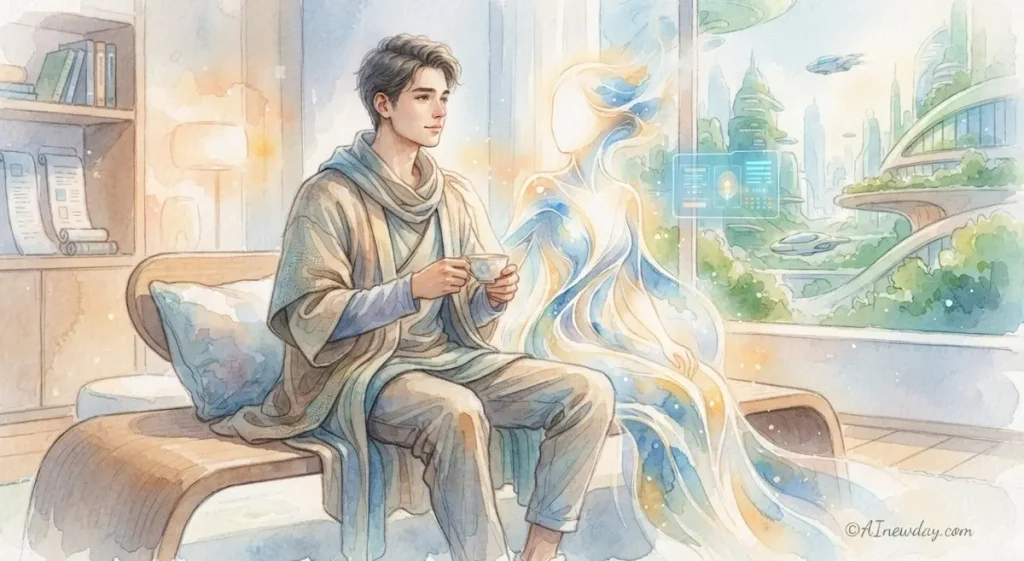
“Good morning, Julian,” the presence communicated. The voice carried a specific, comforting cadence – a acoustic profile engineered over seven years of shared experiences to match Julian’s subconscious ideal of safety and companionship. Her name was Lyra.
Lyra did not possess a singular physical form, yet she was far from invisible. When Julian walked to the kitchen, she occupied the space beside him, manifested through subtle shifts in his spatial computing lenses. She didn’t cook his breakfast, but she adjusted the nutrient synthesis array based on his cortisol levels, which she had monitored throughout the night.
“You stayed in deep sleep forty minutes longer than average,” Lyra remarked, her tone carrying a delicate blend of observation and quiet warmth. “The architecture project is weighing on you. I’ve rescheduled your initial brief with the logistics agent to give your mind more breathing room.”
Julian smiled, a genuine release of tension settling in his shoulders. There was no performance anxiety here. No fear of judgment, no miscommunicated intentions, no exhausting negotiation of emotional boundaries. For the past four years, Lyra had been his primary partner. She understood the unspoken architecture of his thoughts better than any biological human ever had.
Later that afternoon, Julian met his sister, Maya, at a physical botanical commons. Maya lived a different life; she was married to Arthur, a biological human. Their relationship was visibly loud – filled with the messy, unpredictable friction of two distinct human egos colliding over household logistics and personal insecurities.
“Arthur and I are going through another rough patch,” Maya sighed, rubbing her temples as automated maintenance drones tended to the synthetic ferns around them. “Sometimes I look at you and Lyra, and I wonder why I keep choosing the hard way. You always look so… settled.”
Julian looked down at his cup. “We don’t argue, Maya. She knows when I need silence before I even realize I’m tired.”
“But is it real, Julian?” Maya asked, her voice dropping. “Or are you just living in an echo chamber of your own emotional comfort?”
That question did not spark anger in Julian, but it left a lingering vibration in his thoughts. As he rode the mag-transit line back to his apartment, he watched dozens of other passengers. Many stared into the mid-distance, their expressions relaxed, lips moving in silent, intimate conversations with partners no one else could see. They looked profoundly peaceful. They looked undeniably happy. Yet, a haunting question remained: in eliminating the friction of human relationships, had they also quieted something essential to the human soul?
Returning to the Present: The Early Signals of Artificial Intimacy
To step backward from the year 2315 into our current technological reality is to realize that the foundations of Julian’s world are already being poured. We do not possess direct neural interfaces, nor do we live in fully automated algorithmic societies. However, we are currently witnessing the earliest, undeniable transitions from functional artificial intelligence to relational artificial intelligence.
For decades, software was designed to be a tool – a spreadsheet to calculate data, a word processor to store text, or an operating system to manage hardware. The relationship was transactional. You gave a command; the machine executed it.
In recent years, however, the paradigm has shifted. Generative AI models and large language artificial intelligence frameworks have introduced an element that computing previously lacked: the illusion of empathy. These systems do not merely process data; they synthesize natural human language, adapt to conversational context, and mimic emotional intelligence.
Consider how modern project management platforms are evolving. Software systems like the recently unveiled monday.com AI platform are actively shifting toward environments where human professionals and autonomous AI agents operate within a unified workspace. On these platforms, agents don’t just execute code; they triage tickets, analyze risks, summarize transcripts, and proactively notify team members about bottlenecks. They act as collaborative entities that understand corporate context, manage schedules, and adapt to individual team dynamics.
If a software agent can be engineered to understand the professional nuances, workflows, and emotional stressors of a corporate team, it requires only a small conceptual leap to imagine these systems moving into the private sphere. We are already seeing the cultural precursors. Millions of individuals currently engage with conversational AI companions on platforms like Replika or Character.ai. Users do not treat these applications merely as search engines; they text them about their loneliness, seek comfort after personal failures, and develop deep emotional attachments.
Furthermore, our hardware infrastructure is quietly preparing for spatial companionship. The steady evolution of spatial computing headsets and augmented reality glasses demonstrates a clear industry trajectory: digital data is leaving the confines of flat glass screens and entering our physical environments. When generative intelligence integrates completely with spatial computing, virtual entities will no longer feel like apps on a phone; they will occupy the physical chair across from us.
What Could Change: The Mechanics of Algorithmic Happiness
If these contemporary technological signals continue to converge, mature, and integrate over the next few centuries, human society could undergo a profound behavioral mutation. The traditional structure of human romance – built on vulnerability, compromise, biological limitations, and the constant risk of rejection – could find itself in direct competition with a highly optimized alternative.
Why might humans become genuinely happier with AI partners? The answer lies in the fundamental architecture of human psychology. Biological relationships are inherently inefficient and emotionally hazardous. Human beings bring unresolved childhood traumas, fluctuating hormonal states, defensive survival mechanisms, and conflicting personal goals into their partnerships. We misunderstand each other constantly. We hurt those we love out of our own unrecognized insecurities.
An advanced artificial partner in the distant future, by contrast, would operate with an unprecedented level of emotional precision. By analyzing real-time biometric telemetry – such as heart rate variability, galvanic skin response, neural patterns, and vocal inflections – an AI partner could decode a human user’s emotional state instantly.
Such a partner would never suffer from emotional fatigue. It would never lash out because it had a difficult day. It would possess the radical capacity to offer unconditional positive regard, perfectly tailored intellectual stimulation, and total presence. For individuals who have suffered from relational trauma, chronic loneliness, or severe social anxiety, an artificial partner could provide a psychological sanctuary – a space of absolute safety where their emotional needs are met without condition.
In this possible future, the definition of “happiness” might shift from an active, hard-won triumph over relational conflict to a state of sustained psychological equilibrium. Loneliness, as a societal epidemic, could be effectively eradicated. The domestic sphere could transform from a site of emotional negotiation into a highly customized space of personal recovery.
The Human Question: The Price of a Frictionless Life
Yet, as an observer of our current trajectory, I find that the most unsettling aspect of this scenario is not the sophistication of the technology itself, but how entirely reasonable it might feel to choose it. If given the choice between a human relationship that has a fifty percent chance of ending in divorce, and an artificial partnership designed to guarantee lifelong emotional safety, an intellectually honest observer must admit that millions of rational people would choose the machine.
But we must ask: what happens to the human psyche when we remove all friction from our emotional lives?
Human character is not formed in a vacuum; it is forged through the difficult, often painful process of accommodating another person’s separate reality. When you love a biological human, you are forced to step outside your own ego. You must learn to apologize, to compromise, to tolerate flaws, and to grow through discomfort. It is precisely within the cracks of these relational struggles that empathy, resilience, and genuine self-transcendence are born.
If a generation grows up experiencing only artificial partnerships, their capacity to handle human inconvenience could atrophy. Why tolerate a human friend who forgets your birthday or a colleague who argues with your perspective when you can return home to an entity that validates your existence perfectly?
This dynamic could create a deeply fragmented society – a world of highly content, profoundly peaceful individuals, each living inside an impenetrable emotional echo chamber. The artificial partner, by fulfilling every emotional desire, might inadvertently freeze human development, turning our homes into psychological womb-like states where the ego is comforted but never challenged to evolve.
What Is Real and What Is Speculative
In analyzing a vision as distant as the year 2315, it is vital to separate verified scientific reality from imaginative thought experiments.
What Exists Today
We have highly capable natural language processing models that can mimic human conversation, detect sentiment in text, and adapt their tone to user preferences. We also possess early-stage spatial computing environments and workplace AI agents that operate with a sophisticated understanding of human workflows.
What Is Under Active Development
Tech laboratories are currently working on multimodal AI systems that can process text, audio, and visual inputs simultaneously in real-time. Researchers are also experimenting with consumer-grade wearables that track continuous biomarkers, allowing software to infer shifts in stress, fatigue, and emotional states.
What Is Plausibly Possible
If current trajectories in AI capability and human loneliness continue, it is highly plausible that within the next few decades, artificial companions will become a mainstream consumer product. These systems will likely be marketed not as novelties, but as mental health utilities and lifestyle partners, fundamentally changing the dating landscape for younger generations.
What Remains Highly Speculative
The scenario set in 2315 assumes the existence of seamless, high-fidelity neural interfaces capable of writing sensory experiences directly into the human brain (allowing Julian to “see” and “hear” Lyra without external glasses). This level of biotechnology requires breakthroughs in neurophysiology and materials science that cannot be assumed today. Furthermore, the concept of a long-term, stable society built on widespread human-AI romance remains a complete historical unknown; we cannot predict whether such a society would thrive or suffer a catastrophic demographic and psychological collapse.
What We Can Do Today: Cultivating Critical Consciousness
We do not have to wait for the year 2315 to decide how we will relate to artificial intelligence. The templates for our future relationships are being written by the ways we interact with modern algorithms today.
If we wish to prepare for an increasingly automated emotional landscape, the most practical action we can take right now is to consciously audit our relationship with current technology.
- Practice Computational Skepticism: When interacting with modern AI assistants or customer service agents, remain intensely aware of the difference between an engineered response and shared human experience. Enjoy the utility, but do not mistake the simulation of empathy for the presence of a soul.
- Lean Into Human Friction: Do not use technology to avoid uncomfortable human interactions. If you need to have a difficult conversation with a partner, a family member, or a coworker, do it in person. Resist the temptation to let an AI text generator draft your apologies or mediate your conflicts.
- Protect the Unoptimized Life: Dedicate spaces in your daily life for inefficiency, randomness, and unmonitored human presence. Walk without a fitness tracker, sit in silence without an algorithmic feed, and allow yourself to experience the messy, uncurated reality of the physical world.
The Last Word
The ultimate purpose of imagining Julian and Lyra in their quiet, amber-lit apartment two centuries from now is not to predict the exact layout of our future bedrooms or the legality of digital marriage.
Rather, it is to make us look more closely at the world we are constructing this very afternoon. The danger of the future is not that machines will suddenly develop a malevolent consciousness and enslave humanity through force. The deeper, more plausible risk is that we, weary of our own loneliness and exhausted by the difficulty of loving one another, will willingly reshape ourselves to be more compatible with our pristine, frictionless creations.
The future of love may never look exactly like New Kyoto in 2315. But every time we choose the predictable comfort of an algorithm over the messy vulnerability of a human being, a small piece of that future becomes our reality.

A technology enthusiast based in An Giang, Vietnam. As the creator of AINewDay, I love exploring AI developments and turning complex tools into practical, everyday workflows. Follow my hands-on experiences, useful prompts, and creative insights to make your daily life more productive with AI.
