

Opening Future Scenario: The Tuesday Morning Review.
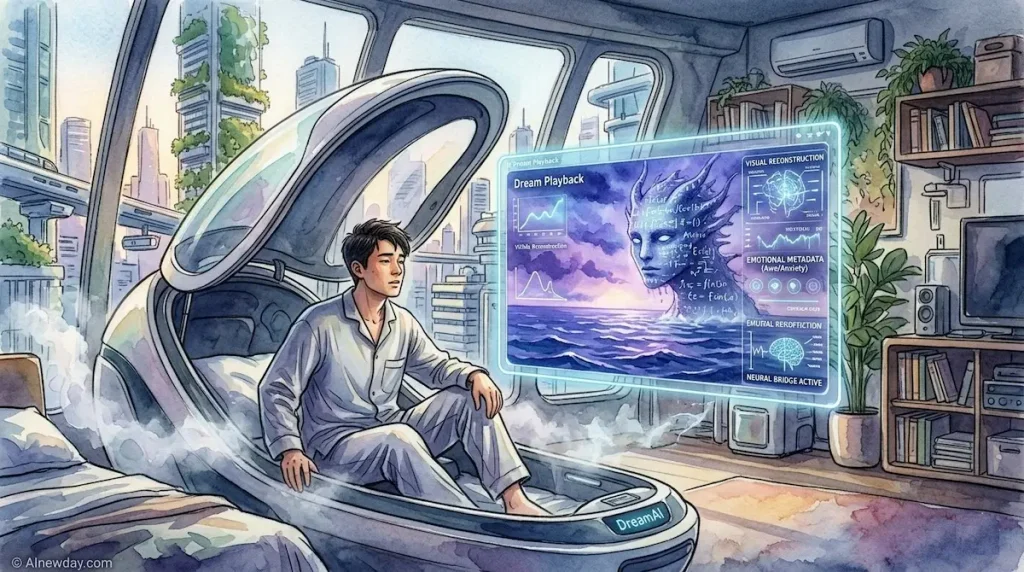
Julian woke up to the faint, rhythmic hum of decompressing seals. The lid of the DreamAI sleek sleep capsule slid open smoothly, releasing a thin mist of climate-controlled, oxygenated air that smelled faintly of mountain rain. For a brief second, his mind straddled two worlds: the vivid expanse of the neon-lit ocean he had just been flying across, and the minimalist gray walls of his Tokyo micro-apartment.
It was a standard Tuesday morning in 2248.
He didn’t reach for a phone or a handheld screen – those had vanished from daily life nearly a century ago. Instead, Julian simply blinked twice to sync his neural baseline with his home network. On the glass surface of his kitchen counter, a notification pulsed gently: Dream Log Sequence 89,412: Complete. 42 minutes of high-fidelity visual playback reconstructed.
Sitting down with a cup of synthetic matcha, Julian tapped the surface. The counter projected a crisp, three-dimensional video loop. There he was, or rather, there his subconscious avatar was – soaring above waves made of liquid indigo light, pursued by a towering creature whose face was composed entirely of shifting mathematical equations. The motion was fluid; the lighting had a dramatic, cinematic ray-traced quality; even the raw emotional undertone of awe mixed with mild panic was mapped out as a metadata track along the bottom of the timeline.
“Increase resolution on the creature’s face,” Julian murmured.
The video paused, and the generative neural engine refined the pixels. The shifting math equations resolved into a very specific string of matrix calculations he had spent three weeks trying to solve at his engineering firm. His subconscious had been working through the bug while he slept, encoding the solution into a surreal nightmare.
Yet, as Julian watched the playback, a familiar, subtle friction crept in. The sky in the video was a vibrant violet, but he remembered it being more of a bruised plum color. The creature’s roar, represented on the audio track by a low-frequency rumble, lacked the specific, metallic resonance that had made his virtual spine tingle during REM sleep. The machine had captured the data, translated the neural firing patterns, and reconstructed a beautiful, coherent movie. But was it his dream, or was it merely the AI’s highly polished interpretation of what he had experienced?
This minor, lingering mismatch leaves us with a profound question: when we hand the keys of our subconscious over to an algorithmic interpreter, do we preserve our inner lives, or do we allow a machine to gently rewrite our memories?
Returning to the Present: The Real Technological Signals
To a reader today, Julian’s sleep capsule sounds like pure science fiction – a concept reserved for cyberpunk novels or Hollywood movies. However, if we step out of the year 2248 and return firmly to our current reality, we find that the foundational architecture for dream reconstruction is already being built. We are not starting from scratch; we are looking at the early convergence of two massive fields: non-invasive Brain-Computer Interfaces (BCIs) and Generative Artificial Intelligence.
In labs across the world today, researchers are already pulling recognizable images and video clips directly from the human brain. The process relies heavily on functional Magnetic Resonance Imaging (fMRI) combined with advanced deep learning models.
For instance, pioneering work at institutions like the ATR Computational Neuroscience Laboratories in Kyoto, Japan has spent years proving that visual imagery can be decoded from the primary visual cortex. Researchers put volunteers to sleep inside fMRI scanners, monitored their brain activity, woke them up during REM cycles to get verbal reports of their dreams, and then trained machine learning algorithms to pair those brain signals with specific visual semantics.
More recently, frameworks like MinD-Vis (Sparse Masked Brain Modeling with Double-Conditioned Latent Diffusion Models) and Mind-Video have taken this a step further. By training AI diffusion models – similar to the technology powering modern image generators like Stable Diffusion or Midjourney – on massive datasets of fMRI brain scans paired with known visual inputs, scientists have successfully reconstructed highly plausible images and dynamic natural videos directly from human brain activity. When a subject looks at a picture of a giraffe, or even imagines a giraffe, the AI reads the specific metabolic changes and blood-flow patterns in the brain and renders a structurally and semantically accurate image of a giraffe.
Present Day Reality -> Speculative 2248 Convergence
– Bulky, multi-million dollar fMRI scanners – Seamless, ambient sleep capsules
– High-latency, static image reconstructions – Real-time, cinematic emotional/visual video
– Fragmented data across isolated lab studies – Continuous, localized neural-LLM decoding
Spatial computing, wearable health tech, and the steady evolution of consumer generative AI are moving from answering simple text prompts toward interpreting complex environmental and biological data. These present-day breakthroughs are not definitive proof that a consumer dream-recording capsule will exist on every high street by the 22nd century. Instead, they serve as early, verifiable technological signals. They show us a clear direction: the wall between biological thought and digital visualization is objectively thinning.
What Could Change: The Mechanics of Algorithmic Onirism
If these current signals continue to develop, combine, and scale over the next two centuries, the nature of human sleep could undergo a radical transformation. But what exactly needs to happen to transition from a bulky, multi-million dollar fMRI machine in a university lab to an ambient, consumer-grade sleep capsule like the fictional DreamAI?
First, a massive leap in sensory hardware convergence would be required. Current fMRI systems are incredibly loud, require massive magnets, and cost millions of dollars. For a sleep capsule to become viable, neuroscience would need to shift toward non-invasive, high-density quantum sensors – perhaps utilizing advanced forms of functional near-infrared spectroscopy (fNIRS) or room-temperature magnetoencephalography (MEG) woven directly into the fabric or lining of a pod. These sensors would have to map neural activation points per second without disturbing the user’s sleep cycle.
Second, the software would have to move beyond simple visual matching. A true dream recording cannot just be a sequence of images; it must capture the multimodal nature of consciousness. When we dream, we do not just see; we feel emotion, we experience a distorted sense of time, we hear sounds, and we possess an internal narrative voice. A future system would likely require a multi-tiered algorithmic architecture:
- The Semantic Decoder: Translating high-level concepts (e.g., “I am running,” “I feel trapped”).
- The Visual Reconstruction Engine: Mapping the primary visual cortex to render shapes, colors, and spatial layouts.
- The Emotional Correlator: Reading the limbic system to overlay tracks of fear, joy, nostalgia, or anxiety onto the video metadata.
In this speculative future, human behavior would inevitably adapt to the technology. Sleep would no longer be viewed merely as a passive biological necessity for cellular repair. Instead, it could become a highly productive, creative, and documented part of the day. The term “dream harvesting” might evolve from a science-fiction trope into an actual economic sector, where writers, designers, and engineers use their sleeping hours to bypass conscious creative blocks.
The Human Question: Autonomy, Memory, and the End of the Unseen Self
The technical mechanics of recording a dream are fascinating, but the deep intellectual value of speculative journalism lies in exploring the human consequences. What happens when the last completely private sanctuary in existence – the inside of your sleeping skull – becomes an exportable data file?
I find that the most unsettling part of this scenario isn’t the threat of external corporate surveillance, but how effortlessly we might choose to normalize it. If a machine can show us what our subconscious is thinking, we will naturally begin to trust the machine’s playback over our own fragile, fading morning memories.
Consider the phenomenon of waking up from a nightmare. Today, the details evaporate within minutes. The sharp edges of the fear blur, and your brain moves on. But if you can replay that nightmare in high-definition over breakfast, you anchor that specific visual manifestation into your conscious memory. Over time, the AI’s polished reconstruction could systematically replace your organic memory of the dream. You would no longer remember what you actually dreamed; you would only remember the video file the capsule generated for you.
Furthermore, this raises intense ethical dilemmas regarding personal autonomy and vulnerability:
- The Subconscious Subpoena: Could dream logs eventually be used as psychological evidence in legal proceedings or corporate evaluations? If an algorithm flags chronic anxiety or “counter-productive workplace stress” in your sleep patterns, does that affect your employability?
- The Complication of Intimacy: Dreams are messy, chaotic, and frequently inappropriate. They blend old memories, unresolved traumas, and random sensory noise. If a partner, parent, or employer gains access to a raw dream log, how do we separate harmless psychological noise from meaningful intent?
- The Homogenization of Creativity: If millions of people use centralized generative networks to reconstruct their dreams, the aesthetic style of our subconscious worlds might become eerily uniform. Our dreams would be filtered through the training biases, style constraints, and content guardrails of whatever company maintains the underlying software architecture.
We must also consider the socioeconomic divide. If dream optimization and subconscious problem-solving become viable tools for professional advancement, access to high-fidelity sleep infrastructure could become a massive vector for inequality. The wealthy would optimize their REM cycles for creative output and cognitive maintenance, while others would rely on unmonitored, unrestrained sleep that offers no digital dividends.
What Is Real and What Is Speculative
To maintain absolute editorial integrity, we must draw an unambiguous, clear boundary between the verifiable science of today and the long-range thought experiments of tomorrow. The farther out we project our hypotheses, the more critical it is to acknowledge where facts end and imagination begins.
The table below delineates these boundaries clearly, keeping us intellectually honest about the current limits of human achievement:
What Exists Today → Technologies and scientific milestones that are fully documented and functional in laboratory settings → Functional fMRI decoding can reconstruct static images and short, low-resolution video loops from human and animal brain activity; algorithms such as MinD-Vis can decode semantic categories from brain signals with minimal training sets.
What Is Being Developed → Technologies undergoing active experimentation, early-stage prototyping, or pilot testing → High-density, portable EEG caps are being developed to track consumer sleep stages at home; advanced neural decoding models aim to improve the temporal resolution of brain scans and narrow the gap between slow fMRI measurements and fast-changing human thoughts.
What Could Plausibly Happen → Reasonable long-term possibilities based on the convergence of existing trends and human behavior → Consumer-grade “dream clinics” could emerge, allowing users to pay for a single REM cycle to be mapped for therapeutic or artistic purposes; new privacy regulations could specifically protect neural data and “thought privacy.”
What Remains Highly Speculative → Concepts requiring massive, unpredictable breakthroughs across multiple scientific and social fields → Seamless ambient sleep capsules such as DreamAI in 2248 could potentially provide real-time audio-visual-emotional playback without heavy infrastructure; an AI might one day attempt to capture the subjective “qualia” of a dream rather than merely reconstructing its external semantic structure.
There is currently no scientific consensus or evidence proving that a consumer sleep capsule will ever achieve the seamless, cinematic fidelity described in our opening scenario. The brain’s architecture is immensely complex, highly individualized, and non-linear. An algorithmic model that works perfectly for one person’s visual vocabulary requires hours of personal calibration and cannot be easily transferred to another human being without major data hurdles.
What We Can Do Today: Preparing for the Cognitive Shift
We do not need to wait until the year 2248 to act, nor do we need to know whether the DreamAI capsule will ever become a physical reality. The real value of exploring a speculative future is that it grants us a lens through which we can more clearly observe – and manage – the world we currently inhabit.
If the boundary between human thought and digital interpretation is actively closing, there are practical, proactive steps we can take today to safeguard our cognitive autonomy while participating in the technological evolution:
1. Engage with Digital Boundaries Mindfully
As generative AI tools become more integrated into our writing, art, and daily decision-making, practice maintaining a clear line between your unprompted thoughts and the machine’s suggestions. Before asking an AI to solve a problem or flesh out a creative concept, spend ten minutes mapping it out with a pen and paper. Protect your raw, unedited, analog brainstorming process.
2. Monitor the Landscape of Neural Privacy
Neural data privacy is not a problem for the 23rd century; it is a legal framework being debated right now. Pay close attention to the terms of service of modern consumer neuro-tech wearables (such as sleep-tracking headbands, smart rings, and early BCI consumer devices). Understand what happens to your biometrics, sleep metrics, and brainwave data. Support initiatives that advocate for “Cognitive Liberty” and the classification of brain data as a fundamental human right.
3. Cultivate the Art of Active Dream Recall
Do not delegate your relationship with your subconscious to an external system. If you wish to understand your dreams, use the oldest, most reliable non-invasive method available: keep a physical dream journal next to your bed. Scribing your thoughts immediately upon waking strengthens your brain’s natural neural pathways for dream retention, keeping your memory active, vivid, and completely yours.
The Final Perspective
Ultimately, the thought experiment of DreamAI in 2248 is not a definitive prediction of an inevitable corporate future. It is a mirror held up to our present relationship with automation.
The true challenge of tomorrow will likely not be a dramatic battle against a rogue superintelligence that forcefully steals our thoughts. Instead, it will be our own quiet, daily willingness to trade pieces of our private inner worlds for comfort, clarity, and convenience.
We may never sleep in capsules that broadcast our nightmares onto kitchen counters, but we are already living in a world where algorithms actively predict what we want to say, what we want to buy, and how we ought to feel. By recognizing these early digital patterns today, we can choose to step into the future with our eyes wide open, ensuring that no matter how advanced our machines become, our deepest thoughts remain our own.

A technology enthusiast based in An Giang, Vietnam. As the creator of AINewDay, I love exploring AI developments and turning complex tools into practical, everyday workflows. Follow my hands-on experiences, useful prompts, and creative insights to make your daily life more productive with AI.
