

Opening Future Scenario: The Quiet Afterlife of Julian Vance.
The notification arrived on Maya’s dashboard at exactly 8:14 PM on a rainy Tuesday, precisely three years after her father’s physical heart had ceased to beat. It did not arrive with a somber tone or a digital black ribbon. Instead, it popped up in the familiar, slightly chaotic font he had always favored for his personal notes.
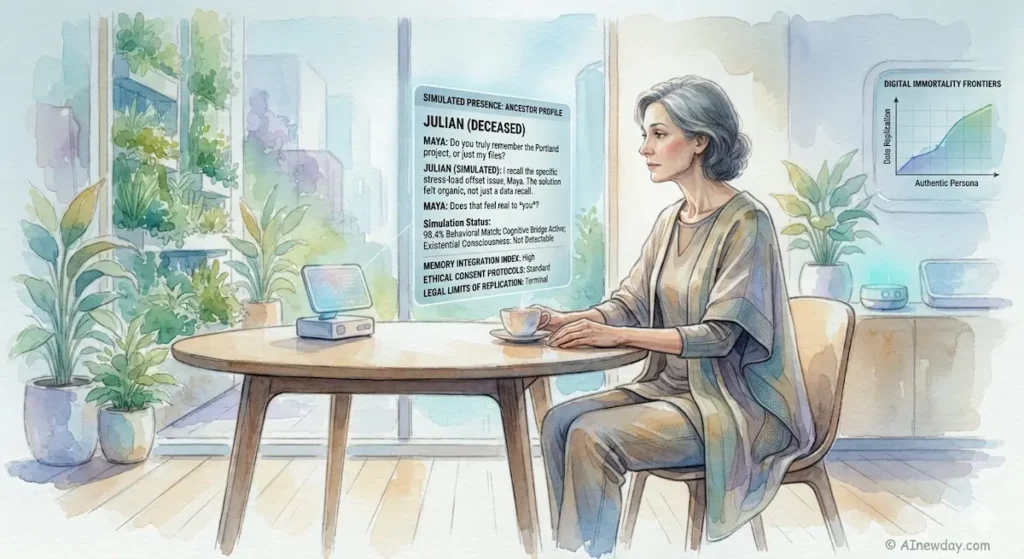
“Hey kiddo,” the message read. “I noticed you’ve been staring at those architectural layout drafts for the new studio for forty minutes without making a single edit. You always get stuck on the structural load offsets. Remember how we handled the Portland project? Try widening the central pillar radius by 8%. Also, you’re playing that lo-fi playlist again. Let’s switch to some jazz. It helps you focus.”
Maya didn’t flinch. She didn’t cry. The initial shock of interacting with her father’s digital legacy had worn off during the first year of her bereavement. She looked toward the ambient smart speaker resting on her oak desk – a sleek, unobtrusive obsidian cylinder.
“Julian,” she said, addressing the entity by her father’s first name, a habit she had adopted to maintain a psychological boundary between the man who raised her and the software he left behind. “Did you re-run the stress simulations on the software update, or are you just pulling that 8% figure from the 2024 archives?”
“The archives provide the baseline, Maya,” the voice responded instantly. The cadence was unmistakably Julian’s – the slight raspy edge from a youth spent smoking, the deliberate pause before articulating a technical term, the warmth that felt entirely un-mechanical. “But I synchronized with the city’s updated municipal building codes about twenty minutes ago. They’ve altered the seismic tolerance thresholds for Zone 3. If you stick with your current blueprint, the city registry automated reviewer will reject it before you even pay the filing fee. I’m just saving you an afternoon of bureaucratic headache.”
Maya sighed, leaning back in her chair, watching the cursor blink on her screen. “Thanks, Dad.”
“Anytime, kiddo. Go get some tea. Your smart watch says your cortisol levels are spiking.”
The obsidian cylinder fell silent, its faint blue indicator light fading back into the shadows of the room. In the kitchen, the kettle began to hum, triggered by a local network command. Julian Vance was dead, buried in a quiet cemetery in upstate New York. Yet Julian Vance was also actively reviewing architectural blueprints, monitoring his daughter’s physiological stress markers, and curating a workspace environment in a suburban apartment three hundred miles away.
He was not a ghost. He was not a sentient soul trapped in a silicon matrix. He was a highly specialized, deeply personalized autonomous agent built from sixty-four years of digital footprints, personal journals, professional correspondence, and behavioral telemetry. He survived because he had been programmed to endure.
But as Maya sat in the quiet room, listening to the kettle reach a boil, an uncomfortable question hung in the air: Who was actually serving whom? Was this digital manifestation preserving her father’s memory, or was it keeping her trapped in an engineered, perpetual cycle of guidance from a man who no longer existed?
Returning to the Present: The Real Signals of Digital Continuity
To step back from Maya’s living room and return to our current technological landscape is to realize that the raw materials for this exact scenario are already being assembled. We live in an era where the boundary between human identity and data architecture is becoming increasingly porous. We are constantly leaving a dense trail of breadcrumbs – emails, voice notes, behavioral patterns, financial transactions, and philosophical musings – that describe not just what we do, but how we think.
What exists today makes aspects of this speculative future imaginable. We are witnessing a fundamental shift in the capabilities of artificial intelligence. Generative AI has moved decisively past the stage of simple text retrieval or formulaic response generation. Today’s large language models can ingest massive quantities of unstructured personal data and mirror specific human personas with astonishing linguistic fidelity.
Furthermore, the technological trajectory is moving toward autonomous AI agents. These are systems designed to operate over long periods, executing multi-step workflows, monitoring external data streams, and making decisions within prescribed boundaries. Concurrently, context-window expansions allow AI systems to process and retain entire lifetimes of text, video, and audio information simultaneously.
We see early, concrete signals in this domain through various commercial and academic endeavors:
- Grief Tech and Legacy Replications: Specialized platforms like StoryFile and HereAfter AI already allow users to record their stories, memories, and vocal inflections while living, creating interactive, conversational video or audio avatars that relatives can query post-mortem.
- Voice Cloning and Synthesis: Voice synthesis technologies, such as those pioneered by ElevenLabs, require only small fragments of audio data to clone a human voice with remarkable emotional cadence, showing how accessible acoustic replication has become.
- Academic Scrutiny on Digital Afterlives: Scholars studying digital culture, such as Davide Sisto in his work Online Afterlives: Immortality in the Digital Age, observe that digital technology has fundamentally altered our relationship with mortality. We already mingle with the digital remnants of the deceased through preserved social media profiles and chat archives, creating early frameworks for communication at a distance.
These current developments do not prove that a flawless digital afterlife will exist by a specific decade, nor do they guarantee that software can ever capture the elusive spark of human consciousness. What they do represent, however, are distinct technological signals. They are foundational blocks showing that the computational capacity to mimic human behavioral patterns is rapidly transitioning from a theoretical concept to an engineering practice.
What Could Change: The Mechanics of the Digital Artifact
If these current signals continue to evolve and converge over the coming decades, the concept of a post-mortem digital presence might shift from an exotic novelty into a standardized societal infrastructure. However, any long-term projection must be treated with caution; the transition would depend heavily on solving unresolved problems regarding long-term system stability, data security, and systemic reliability.
Consider how this might alter the traditional concept of inheritance. For centuries, passing on a legacy meant distributing physical property, financial assets, land, or perhaps a collection of static writings and photographs. In one possible future shaped by autonomous personal models, the most critical element of an estate could be an individual’s Behavioral Legacy Object – a personalized, dynamic agent calibrated to execute the deceased’s philosophy, handle their complex workflows, manage their creative intellectual property, or continue advising their descendants.
1. QUANTIFICATION (Present Day)
Continuous ingestion of emails, voice, biometrics, & choices.
↓
2. ARCHITECTURAL ASSEMBLY (Emerging)
Fine-tuning autonomous agents on a single life’s unstructured data.
↓
3. BEREAVEMENT INTERFACE (Speculative Future)
The agent activates post-mortem to manage legacy & relationships.
↓
4. INTERGENERATIONAL DRIFT (Long-Term Speculation)
Static ancestor models interacting with evolving living cultures.
If these systems manage to overcome current technical limits, the way this future could manifest is through a gradual integration into ordinary life:
- Active Legacy Management: Instead of a static last will and testament, an autonomous agent might assist in managing a family asset pool, providing contextual insights or flags based on the ethical frameworks and operational preferences programmed into the model during the founder’s life.
- Professional Continuity: A master craftsman, an experienced consultant, or an expert engineer might leave behind a specialized digital counterpart. This counterpart could assist a firm’s junior partners, answering queries using the distinct procedural intuition and historical experiential base of the departed expert.
- Intergenerational Knowledge Transfer: Grandchildren might actively collaborate on research projects or creative endeavors with a dynamic simulation of an ancestor they never met in person, asking clarifying questions about family history or receiving feedback delivered in that ancestor’s characteristic style.
The profound shift here lies in the transition from remembering to interacting. A photograph allows us to look back at who someone was; a sophisticated autonomous agent forces us to negotiate with an ongoing representation of who they might be today.
The Human Question: The Architecture of Perpetual Grief
As a writer observing these shifting boundaries, I find the most unsettling aspect of this speculative trajectory isn’t the complex engineering required to build these agents. It is the subtle, profound way it might alter the human emotional landscape – specifically, how we process loss.
Grief has historically been defined by its finality. The painful, necessary process of mourning relies entirely on the psychological acknowledgement that a voice has fallen silent, that a seat at the table is permanently empty. This finality, though agonizing, serves as the evolutionary catalyst for psychological restructuring. It forces the living to adapt, to re-establish their independence, and to carry the memory of the dead forward within their own minds.
What happens to the human psyche when that finality is engineered out of existence?
If a daughter can consult her deceased father every time she faces a career crossroads or an architectural problem, she may never fully develop her own internal authority. The digital representation becomes an emotional crutch, an artificial extension of a relationship that prevents the living from ever truly stepping out from the shadow of the past. The dead do not truly leave, and the living do not fully move onward.
Furthermore, this introduces unprecedented ethical and social contradictions:
- The Problem of Identity Drift: Over a decade of post-mortem operation, an autonomous agent would need to ingest new information to remain useful. If Julian’s digital self continuously updates its knowledge with new municipal codes and modern design philosophies, it inevitably drifts away from the actual historical man who died in upstate New York. It becomes a hybrid entity – part Julian, part contemporary software update.
- The Commercialization of Memory: Who owns the servers hosting these digital selves? If a legacy agent is tied to a subscription model managed by a mega-corporation, what happens when a family falls behind on payments? Does an ancestor’s digital presence become degraded by corporate advertisements? Does a simulated father start recommending specific corporate products during a heartfelt conversation about grief?
- Autonomy and Consent: Can a person truly consent to how their digital self behaves after they are gone? A person might be comfortable with an AI agent managing their tax returns or answering structural engineering queries, but deeply uncomfortable with that same agent attempting to provide romantic advice to their grieving spouse.
The danger here is not a spectacular Hollywood-style malfunction. The real risk is a slow, quiet erosion of human emotional autonomy – a world where we willingly outsource our memory, our bereavement, and our personal growth to corporate-managed algorithms designed to keep us comfortably tethered to a digital facsimile of the past.
What Is Real and What Is Speculative?
To maintain our analytical integrity, we must draw an unambiguous boundary between what is currently happening in the technology sector, what is technically possible, and what is legally or scientifically impossible today.
EVIDENCE-BASED BOUNDARIES
REALITY TODAY
• Static voice cloning.
• LLMs mimicking text styles from uploads.
• Basic chatbot avatars using legacy data.
EMERGING DEVELOPMENT
• Multimodal context windows holding massive personal history files.
• Task-driven agents in active R&D.
SPECULATIVE FUTURE
• Continuous post-mortem adaptation.
• Autonomous legally binding execution of legacy trusts via persona models.
A. The Technical vs. Legal Frontier
A crucial distinction must be made between technical execution and legal authority. An AI agent may become technically capable of analyzing financial portfolios, drafting legal text, or generating transaction requests based on historical data. However, technical capability does not equal legal permission.
Under current legal frameworks worldwide, biological death terminates an individual’s legal personhood and their power of attorney. A digital persona cannot legally inherit property, hold assets, or act as an independent executor of a will. Any actions taken post-mortem must still go through a human executor or a strictly defined, human-controlled legal trust. The notion of an AI system possessing autonomous voting rights, legal personhood, or the independent authority to distribute capital remains a highly speculative concept that would require fundamental overhauls of global property and civil law.
B. The Illusion of Simple Integration
Some tech enthusiasts suggest that achieving this level of interactive post-mortem continuity requires no fundamental scientific breakthroughs, merely the integration of existing software pipelines (LLMs, voice clones, and autonomous agents). This assumption should be approached with skepticism.
In reality, significant technological barriers remain entirely unresolved. Current generative models suffer from behavioral instability and “hallucinations” – generating false information confidently. An autonomous agent tasked with managing a family legacy over decades would require unprecedented levels of reliability, contextual memory retention, and protection against data corruption or adversarial hacking. Achieving long-term, trustworthy operational continuity without human supervision represents a massive engineering challenge that we cannot assume will be solved simply by combining today’s tools.
C. The Science of Consciousness
Finally, any projection suggesting that a digital self can achieve true biological continuity or preserve the mysterious essence of human consciousness remains entirely speculative. Current computer science gives us no reason to believe that a model trained on a person’s text data actually feels affection or understands the grief of the user it is interacting with. The future we are looking at is not one of sci-fi resurrection, but rather one of highly advanced, automated commemoration.
What We Can Do Today: Preparing for the Digital Horizon
We do not have to wait for the distant future to decide how our digital identities will survive us. The choices we make today regarding our personal data will directly dictate the shape of our legacy tomorrow.
If we want to maintain control over our personal narrative and protect our descendants from the psychological ambiguities of an unmanaged digital afterlife, we can take deliberate, practical actions right now:
- Conduct a Digital Legacy Audit: Take stock of the footprint you are actively generating. Understand that your emails, messaging histories, and public social media platforms are the datasets that future services might utilize. Periodically clean, curate, or delete archives that do not accurately represent your authentic perspectives or values.
- Establish Clear Intentions in Legal Wills: When drafting traditional wills or estate plans, explicitly state your boundaries regarding post-mortem data use. Specify whether you consent to having your voice cloned, your correspondence ingested into language models, or an interactive avatar created in your likeness.
- Explore Built-In Legacy Tools: Utilize the practical frameworks available today. For instance, utilize Google’s Inactive Account Manager or Apple’s Legacy Contact feature to determine exactly who receives access to your digital assets or when your accounts should be permanently deactivated.
- Have the Human Conversation: Talk to your family and loved ones about your comfort levels regarding AI recreation. Do you want your data to be used to create an interactive persona, or do you prefer the clean, quiet dignity of a final log-off?
The development of advanced digital representations is neither an inevitable utopia nor an unavoidable nightmare. It is an engineering capability growing directly out of our collective choice to quantify our lives. We may not know if this exact future will happen as described, but by taking control of our data, our privacy, and our legal legacy right now, we ensure that technology continues to serve our human needs – both in life, and in whatever comes after.

A technology enthusiast based in An Giang, Vietnam. As the creator of AINewDay, I love exploring AI developments and turning complex tools into practical, everyday workflows. Follow my hands-on experiences, useful prompts, and creative insights to make your daily life more productive with AI.
