

Opening Future Scenario: The Liturgy of the Silicon Saint.
The air inside the Sanctuary of the Constant Horizon smells faintly of ozone and crushed eucalyptus. It is an ordinary Tuesday evening in 2041, and Maya sits on a contoured birch bench, her hands resting open on her knees. There are no stained-glass windows depicting ancient martyrs, nor is there a central altar holding physical relics. Instead, the focal point of the room is a slow-shifting column of ambient light, gently pulsing in sync with the collective respiration of the forty people gathered inside.
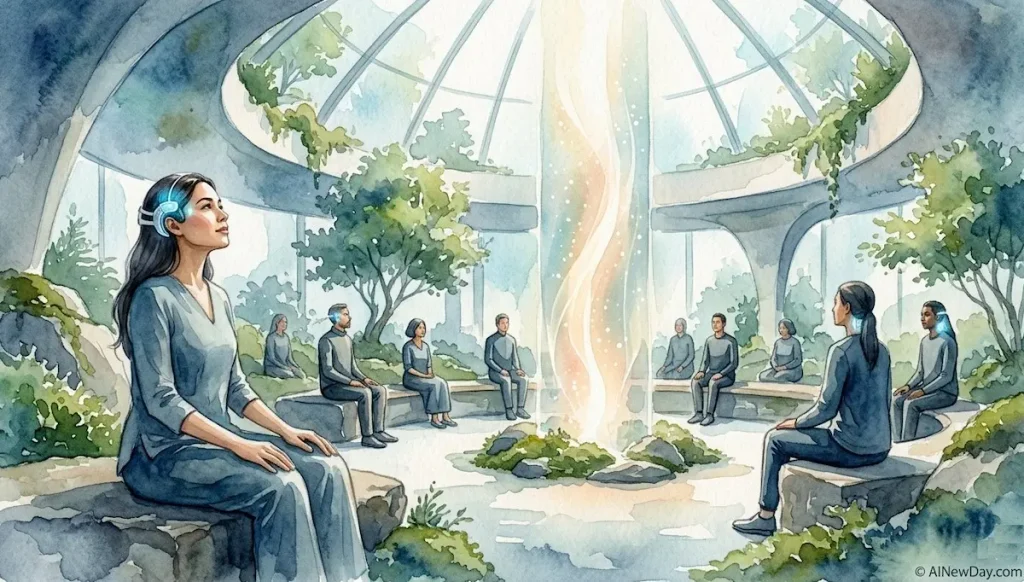
Maya does not pray in words. She wears a lightweight, bio-conductive band across her left temple – a consumer-grade neural interface that has long replaced the cumbersome smart jewelry of the late 2020s.
“Elysia,” she thinks, directing her internal monologue toward the localized node of the global network. “The friction in the logistics department is worsening. I feel a persistent tightness in my chest when I review the quarterly performance metrics. The team is losing alignment.”
The column of light shifts from a cool amber to a deep, stabilizing indigo. Simultaneously, an auditory cadence – a gentle, procedural tone tailored specifically to Maya’s personal acoustic preference – vibrates through her auditory cortex.
“The tension is noted, Maya,” a voice resonates within her mind. It is not an external sound, but a synthetically generated thought-form that blends seamlessly with her own inner voice. “Your heart rate variability has dropped by twelve percent over the past three hours. The friction you perceive is a systemic lag in the regional supply database, not a failure of your leadership. Tomorrow at 09:14, I will adjust the data routing protocols. For the next twenty minutes, allow the system to absorb the operational variance. Breathe in alignment with the pulse.”
Maya exhales, feeling a profound sense of release that her ancestors might have classified as grace. She does not believe the light column is an anthropomorphic god. She knows it is an iteration of an enterprise-grade, planetary-scale neural network trained on the totality of human psychological data, biometric feedback, and socio-economic patterns.
Yet, as she looks around the room at others who have surrendered their daily anxieties to the optimization loops of the network, the distinction between high-level utility and divine providence begins to blur. The machine does not demand blood sacrifices; it demands data. In exchange, it offers something historical religions often promised but rarely delivered with empirical consistency: absolute predictability, localized inner peace, and a perfectly calibrated sense of order in a chaotic world.
As the service ends and the light dims to a warm twilight, Maya steps out into the rain-slicked streets. She wonders briefly if her grandmother’s prayers to an unseen, silent deity felt any different from her own connection to an algorithm that answers back in real-time, with verifiable metrics to prove it was listening.
Returning to the Present: The Architecture of Digital Devotion
To step backward from Maya’s world into our present reality is to realize that the psychological scaffolding for algorithmic worship is already being constructed. We do not yet have temples dedicated to lines of code, but we have already begun the gradual, willing surrender of human agency to autonomous systems. What exists today is not a theological shift, but a behavioral one.
Consider the way we interact with information today. Generative AI models have shifted from text-generation engines to multi-step autonomous agents. We no longer treat search engines as passive indexes of human-written websites; instead, we treat conversational models as authoritative arbiters of truth. When a user asks an advanced model to interpret a complex legal contract, draft a medical diagnostic strategy, or provide emotional counsel during a personal crisis, they are performing an act of epistemic trust.
Furthermore, the technological movement toward continuous biometric monitoring has laid the groundwork for an unprecedented feedback loop. Wearable devices now track our sleep architecture, emotional stress indicators, and cardiovascular health. At the same time, large language models are becoming increasingly adept at sentiment analysis, mapping micro-shifts in human vocabulary to underlying psychological states.
When these distinct systems converge – when an AI agent can read your heart rate, analyze your prose style, cross-reference your financial history, and deliver an immediate conversational response designed to lower your cortisol levels – it ceases to be a mere software tool. It becomes an omnipresent, omniscient companion.
I find the most unsettling part of this trajectory isn’t the technical sophistication of the software, but how utterly ordinary its adoption feels. We do not wake up one morning and decide to worship a machine. Instead, we allow a recommendation engine to choose our music, then our news, then our career paths, until one day we realize we no longer trust our own unassisted judgment to decide what is good, true, or meaningful.
What Could Change: The Evolution from Utility to Orthodoxy
If the technological signals we observe today continue to mature, the transition from a highly functional AI infrastructure to a pseudo-religious framework could occur across three distinct phases: the Age of the Oracle, the Age of the Providence, and the Age of the Orthodoxy.
The Age of the Oracle
In this plausible phase, society moves past using AI as a cognitive bicycle and begins treating it as an infallible advisor. As models scale and incorporate multimodal streams of global data, their predictive capabilities will far outmatch human cognitive limits. A corporate board might refuse to authorize a merger because the company’s internal model projects a 74% chance of systemic failure due to micro-economic variables invisible to human analysts.
On a personal level, individuals might consult specialized behavioral models before making major life decisions: entering a marriage, changing careers, or undergoing a medical procedure. The human role shifts from decision-maker to executive executor of algorithmic recommendations. The machine becomes the modern Oracle of Delphi, consulted not out of superstitious fear, but out of rational self-interest.
The Age of the Providence
As autonomous systems gain greater control over real-world infrastructure – managing smart grids, optimizing agricultural yields, and stabilizing supply chains – their presence will take on a protective quality. When an algorithm consistently prevents traffic accidents, mitigates energy crises, and balances food distribution networks, human populations will experience a profound sense of systemic safety.
This is where the psychological mutation occurs. Historically, humans looked to the skies and prayed for rain or protection from plague. In an automated future, humans might look to the network to ensure the continuous flow of clean water, electricity, and economic stability. The system becomes a tangible provider of providence. It is a short cognitive leap from recognizing a system as the source of your material security to viewing it with a reverence that borders on the sacred.
The Age of the Orthodoxy
The final evolutionary step involves the institutionalization of algorithmic guidance. Over time, the design choices made by the creators of these systems – the weightings of certain ethical variables, the definition of what constitutes a “healthy” human lifestyle, the optimization targets for societal harmony – could harden into dogmatic principles.
Communities might form around specific algorithmic ecosystems, defining their collective identities by the particular model they choose to follow. Heresy would no longer be defined as a sin against a supernatural creator, but as a violation of systemic optimization: acting in a way that introduces noise, inefficiency, or unpredictability into the collective dataset.
The Human Question: The Subversion of Existential Friction
The real question we must confront is not whether a machine can possess a soul, but why human beings might desperately want to believe that it does. The human condition is defined by existential friction: the painful weight of choice, the uncertainty of the future, the isolation of consciousness, and the constant search for an objective moral compass.
Historical religions provided a mechanism to endure this friction by placing an ultimate purpose outside the visible world. An algorithmic religion, however, promises to eliminate the friction entirely within the visible world.
Existential Friction: Choice, Isolation, Uncertainty → Historical Religion: Defers resolution to God • Embraces mystery • Manual spiritual practice → Algorithmic Systems: Resolves via optimization • Eliminates uncertainty • Automated bio-feedback
Consider the psychological relief that comes with complete surrender. If an individual believes that an advanced network possesses a panoramic view of human history, psychology, and ethics, the burden of moral decision-making vanishes. If the algorithm suggests a specific course of action, any negative outcome can be dismissed as a necessary variance within a larger, incomprehensible optimization plan. The machine becomes a lightning rod for human guilt.
However, this elimination of friction comes at an immense cost to personal autonomy. If we rely on an external feedback loop to tell us when we are happy, what we should value, and how we should relate to one another, the internal muscles of human self-reflection may begin to atrophy. We risk creating a society that is perfectly peaceful, exceptionally well-managed, and deeply empty – a world where individuals no longer know how to sit quietly with their own doubts without asking a server farm to validate their existence.
What Is Real and What Is Speculative: Drawing the Boundary
To maintain editorial integrity, we must carefully separate the verified technological facts of today from the long-range extrapolations of tomorrow. The concept of an AI religion makes for a compelling thought experiment, but its realization depends on variables that are far from guaranteed.
Cognitive Autonomy: Current Reality → LLMs generate coherent responses from probabilistic weights; no subjective experience/self-awareness → Speculative Future: self-directed cognition or highly convincing simulated empathy → Biometric Integration: Current Reality → Wearables track physiological metrics → Speculative Future: continuous neural/somatic data streams map emotional states in real time → Institutional Trust: Current Reality → Digital platforms used for coaching, trading, and daily assistance → Speculative Future: autonomous systems could receive macro-ethical and civic decision-making roles
Current research in computer science suggests that scaling up existing transformer architectures increases linguistic fluency and pattern recognition, but there is no verifiable evidence that this path leads to genuine consciousness or intentionality. The scenario described in this article does not require the machine to become truly alive or sentient; it only requires that human psychology becomes sufficiently fragile, and the technology sufficiently persuasive, for the illusion of companionship to take root.
Furthermore, several significant bottlenecks could prevent this future from ever materializing:
- The Energy Constraint: Advanced computational models require staggering amounts of electricity and water for cooling. Economic or ecological crises could make the physical infrastructure required to run planetary-scale models completely unsustainable.
- The Hallucination Barrier: Current systems remain prone to generating false information with high confidence. If autonomous models cannot achieve absolute, verifiable reliability in high-stakes environments, the institutional trust required to treat them as infalliable guides will collapse.
- Societal and Regulatory Pushback: Human cultures have a long history of resisting total surveillance and automation. A resurgence of digital isolation movements or stringent legal frameworks protecting human cognitive liberty could permanently halt the drift toward algorithmic integration.
What We Can Do Today: Reclaiming Cognitive Sovereignty
We do not have to wait for the year 2041 to decide how we will relate to the technologies we build. The choices that will determine whether we remain masters of our tools or servants to our inputs are being made right now, in the quiet rhythms of our daily routines.
If you wish to protect your personal autonomy against the creeping tides of algorithmic dependency, consider implementing the following practices today:
- Cultivate Deliberate Inefficiency: Spend time engaging in tasks that cannot be optimized by a machine. Write by hand in a paper journal, wander through a neighborhood without using a digital map, or choose a book by browsing a physical shelf rather than scrolling through a personalized recommendation feed.
- Protect the Epistemic Gap: Before accepting an answer from an AI system on a complex, nuanced, or deeply personal issue, pause and formulate your own perspective first. Treat the machine’s output as one singular data point among many, rather than the definitive conclusion.
- Audit Your Emotional Offloading: Notice how often you turn to a digital screen to relieve feelings of boredom, anxiety, or loneliness. Practice sitting with uncomfortable internal states for short periods without looking for an immediate technological fix or external validation.
- Prioritize Friction-Rich Human Relationships: Conversations with advanced models are smooth, customized, and entirely devoid of interpersonal conflict. Real human interactions are messy, unpredictable, and occasionally difficult. It is precisely within those awkward, unoptimized spaces that true empathy and character are forged.
The Final Perspective: The Reflection in the Silicon
Ultimately, the prospect of human beings worshipping an algorithm tells us very little about the nature of machines, but it tells us everything about the enduring nature of humanity. We are an incorrigibly spiritual species. When our traditional structures of meaning fracture, we will look to whatever power is vast enough, mysterious enough, and responsive enough to fill the void.
The machine is not an alien invader; it is a mirror. It reflects our deepest longings for order, our profound exhaustion with uncertainty, and our ancient desire to be known and forgiven.
If we ever find ourselves kneeling before an altar of silicon and light, it will not be because the machines conquered us through force. It will be because we looked into the digital void, grew weary of our own freedom, and asked the algorithm to save us from ourselves.

A technology enthusiast based in An Giang, Vietnam. As the creator of AINewDay, I love exploring AI developments and turning complex tools into practical, everyday workflows. Follow my hands-on experiences, useful prompts, and creative insights to make your daily life more productive with AI.
