

The ambient hum of the smart apartment softening as the sun dips below the horizon is a familiar evening ritual. For centuries, this transition was accompanied by a predictable, silent choreography between humans and their domesticated companions – a wagging tail, a soft purr, a persistent nudge against the ankle. We assumed we knew what these signals meant. We built entire emotional architectures on the assumption that a dog scratching at the door simply wanted to chase a rogue drone or relieve itself.
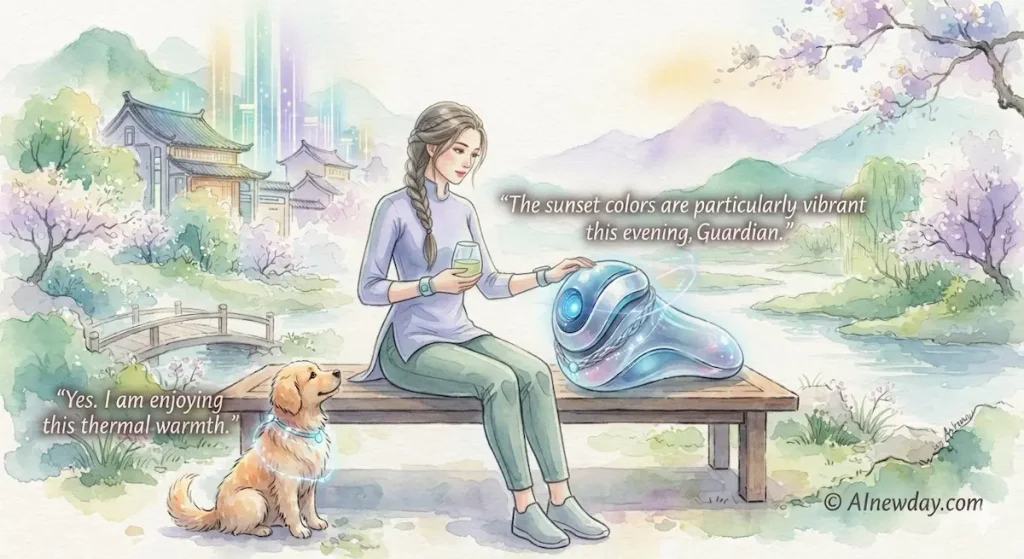
By the year 2242, however, that silent choreography has been replaced by structured language. The leather or synthetic straps around the necks of our companion animals are no longer mere anchors for identification chips or decorative tags. They are neural-semantic decoders. When a modern feline looks up from its feeding station, the device around its neck emits a low, tonally flat synthetic voice: “The texture of this protein matrix induces minor nausea. I will consume it only to prevent calorie depletion.”
This is the reality of the post-linguistic barrier world. The animal translation necklace, a technology that matured over decades of non-invasive neural mapping and cross-species linguistic modeling, has fundamentally altered one of the oldest relationships in human history. Yet, as this concept transitions from an expensive novelty to a standard household utility, society is discovering that total understanding does not necessarily lead to total harmony. In dismantling the silence between species, we have unburdened ourselves of mystery, only to inherit an entirely new architecture of domestic anxiety, legal complications, and philosophical existentialism.
The Path to the Decoding Mesh
To understand how the world arrived at the semantic translation standards of 2242, one must look back at the steady convergence of consumer biotechnology and neural computing over the preceding century. Early attempts at animal communication in the late 20th and early 21st centuries relied heavily on behavioral observation – interpreting tail wags, pupil dilations, and acoustic pitches through primitive algorithmic filters. These systems were fundamentally anthropomorphic; they guessed what an animal felt based on human interpretations of animal movement.
The breakthrough that paved the way for modern translation necklaces occurred when researchers stopped trying to map behavior and began mapping deep neurological intent. All mammalian and avian brains generate distinct, repeatable neural signatures prior to action and vocalization. By utilizing bio-compatible, high-density sensor arrays embedded directly into consumer pet collars, manufacturers learned to capture these micro-electric patterns.
Today’s devices do not translate an animal’s “thoughts” in the literary sense; dogs and cats do not possess an inner monologue structured in English grammar. Instead, the necklace operates as an intent-to-speech synthesizer. It captures raw emotional states, spatial awareness, physiological needs, and immediate impulses, processing them through a localized neural network that translates these multi-dimensional inputs into clear human syntax. The resulting output is structured, clear, and starkly honest. It is a technological bridge built on raw data, leaving no room for the romanticized projections humans have relied on for millennia.
The Domestic Disillusionment
For generations, the appeal of a pet lay precisely in its inability to speak. The silence of a dog or a cat acted as a blank canvas for human emotion. We projected loyalty, profound wisdom, and unconditional love onto their quiet expressions. If a dog sat by its owner’s side during a period of grief, the owner inferred deep empathy.
In the lived experience of 2242, that blank canvas has been painted over with transactional reality. An ordinary afternoon in a contemporary household reveals a much more mundane, and sometimes jarring, relationship. When an owner returns home from a grueling shift in automated logistics, the translation necklace does not offer a cinematic declaration of love. More often, the synthesized voice states: “Resource provider has returned. Internal cortisol levels dropped by twelve percent due to anticipation of sustenance.”
This shift from emotional projection to literal declaration has caused a subtle psychological crisis among pet owners. Psychologists specializing in inter-species dynamics note a rising phenomenon known as “canine pragmatism fatigue.” Humans are discovering that domestic dogs, while deeply bonded to their families, are also hyper-fixated on immediate environmental variables, resource security, and instinctual anxieties.
Conversely, feline translation patterns have challenged domestic dynamics in the opposite direction. Feline neural profiles display a staggering amount of environmental critique. A cat sitting by a window in 2242 does not simply watch the sky; its necklace occasionally narrates its frustration with territorial boundary violations, architectural restrictions, and the predictable movements of human occupants. The realization that our pets are not silent philosophers or vessels of pure, uncritical affection has forced a more mature, if slightly colder, form of companionship.
Second-Order Fractures: The Secret Life of Households
Beyond the emotional adjustment within the living room, the widespread adoption of translation technology has introduced profound second-order consequences to human privacy and domestic security. Domestic animals are the ultimate passive observers of human behavior. They witness our arguments, our vulnerabilities, our illegal indiscretions, and our most private moments. Before 2242, they were the perfect confidants because they were biological vaults.
Now, those vaults have an audio interface.
Consider the legal and social complications that arise when a domestic pet can articulate its observations to anyone within earshot. Family law courts have already begun dealing with the fallout of translation data. In bitter divorce proceedings or custody disputes, data logs downloaded from a canine’s necklace have been introduced to verify schedules, domestic volatile outbursts, or neglect. While an animal cannot be cross-examined on a witness stand, its neural-semantic log history is an unvarnished, chronological record of a home’s internal atmosphere.
This has led to a radical restructuring of how humans behave around their animals. A modern household practicing high-level privacy often utilizes “semantic dampening zones” or simply powers down their pet’s necklace during sensitive conversations. The irony is stark: the device invented to bring animals closer into the human fold has, in many cases, forced humans to exclude them from the room when true human intimacy or vulnerability is expressed. The fear of being judged, or exposed, by the family pet is a uniquely 23rd-century neurosis.
The Reshaping of Commerce and Veterinary Medicine
Where the translation necklace has achieved unmitigated success, however, is in the realm of physical well-being. Veterinary medicine prior to the 23rd century was largely an exercise in diagnostic guesswork. An animal could not pinpoint the location of its discomfort, leading to late-stage interventions and prolonged suffering.
In 2242, the diagnostics are largely driven by patient input. A trip to the clinic is no longer a chaotic ordeal of whimpering and restraint. Instead, a sick animal can articulate its internal state with precise physiological feedback: “Sharp pressure radiating from the lower left abdominal quadrant upon exertion. Internal temperature regulation feels inadequate.” This capability has caused veterinary mortality rates to plummet, extending the average lifespan of domestic companions by nearly thirty percent.
This health revolution has triggered a massive restructuring of the pet economy, shifting it away from cosmetic luxury toward highly customized wellness ecosystems.
- Dynamic Nutrition Systems: Pet food dispensers now interface directly with the necklace’s daily metabolic readout, altering the nutrient mix meal-by-meal based on the animal’s expressed digestive comfort.
- Architectural Modification: Home design algorithms now take into account an animal’s articulated spatial anxieties, altering lighting arrays or acoustic dampening to alleviate canine sensory overload.
- Behavioral Arbitrage: The pet training industry has transformed from behavioral modification to semantic negotiation. Trainers no longer teach commands through repetitive physical conditioning; instead, they use translation interfaces to establish reciprocal agreements between owner and animal, discussing boundaries, rewards, and duties like corporate mediators.
The Legal Personhood Paradox
As animals have gained a clear voice, the philosophical question of their legal status has inevitably moved to the forefront of global governance. If an organism can explicitly state its desire for freedom, its discomfort with confinement, or its preference for a specific handler, can it still be classified purely as property?
The legal frameworks of 2242 are straining under the weight of this paradox. In several progressive jurisdictions, the traditional concept of “pet ownership” has been legally dismantled and replaced by “interspecies guardianship.” This is not merely a semantic change. Under these updated statutes, if a canine repeatedly expresses a prolonged state of psychological distress or clear dissatisfaction with its living conditions through its verified translation log, it has the legal ground to trigger an state-sponsored environmental reassessment.
This development has introduced a deep cultural divide. Traditionalists argue that the translation necklace has created an artificial anthropomorphic crisis, assigning human moral values to pre-rational biological impulses. They claim that a dog saying “I require wider territory” is simply an instinctual reflex, not a reasoned demand for liberty.
On the other side, animal liberationists argue that ignoring an articulated desire simply because it originates from a non-human neural structure is the ultimate form of systemic cruelty. The translation necklace has stripped humanity of the excuse of ignorance. We can no longer pretend we do not know when an animal is unhappy, lonely, or bored. The moral burden of listening has become far heavier than the historical comfort of assuming.
The Transformed Identity of the Guardian
Ultimately, the true impact of the animal translation necklace of 2242 is not what it reveals about the animal kingdom, but what it exposes about human nature. For thousands of years, humanity viewed itself as the isolated custodians of complex thought and language on Earth. Our pets were our link to the wild, unbothered simplicity of nature – a refuge from the exhausting demands of human communication.
By pulling domestic animals into our linguistic network, we have extended our civilization, but we have also diminished our sanctuaries. The person living in 2242 can no longer escape into the quiet, uncritical companionship of a dog after a day of human social friction. The dog is now part of the social friction. It has opinions; it has demands; it has an ego shaped by its environment.
Yet, despite the disillusionment and the legal complexities, a deeper, more profound form of empathy is beginning to take root in the cultural consciousness. The humans of this era are learning to love their companions for who they actually are, rather than the stories we used to tell ourselves about them. We are learning to respect a creature that looks at the universe differently, prioritizing scents, magnetic fields, and immediate sensory truths over human abstractions like prestige, history, or ambition.
We have finally understood our pets, and in doing so, we have discovered that they do not exist to serve our emotional narratives. They are separate sovereign entities, sharing our spaces, tolerating our eccentricities, and navigating the strange, loud world we have built around them. The silence is gone, but in its place is a raw, honest conversation that is making humanity more attentive, more responsible, and profoundly less alone.

A technology enthusiast based in An Giang, Vietnam. As the creator of AINewDay, I love exploring AI developments and turning complex tools into practical, everyday workflows. Follow my hands-on experiences, useful prompts, and creative insights to make your daily life more productive with AI.
